
Related coverage: Auto Insurance, General Liability Insurance, Commercial Auto Insurance
TL;DR: Florida's respondeat superior doctrine can hold your business liable for accidents caused by employees driving personal vehicles on work-related tasks. The employee's personal auto policy is first in line, but its limits may not be enough and some policies exclude business use. A hired and non-owned auto (HNOA) endorsement or standalone policy is typically the right tool to close the gap.
What You Need
- A clear written policy defining when employees may use personal vehicles for work
- Proof that employees carry adequate personal auto liability limits (get certificates of insurance where practical)
- A commercial auto insurance policy or a hired and non-owned auto (HNOA) endorsement on your business auto or general liability policy
- Florida workers' compensation coverage if employees are injured during the errand (see workers' comp)
- A Florida-licensed insurance professional who can review actual policy language, not just the declarations page
Step 1: Understand How Florida Law Attaches Liability to Your Business
Florida follows the common-law doctrine of respondeat superior: an employer is vicariously liable for an employee's negligent acts committed within the scope of employment. The Florida Supreme Court has applied this doctrine broadly. If an employee is picking up supplies, dropping off a deposit, or making a client delivery, that trip is likely "within scope" even if the car belongs to the employee.
Florida also has a dangerous instrumentality doctrine. Under it, the owner of a motor vehicle who entrusts it to another can be held liable. When the employee owns the car, your exposure comes primarily through respondeat superior rather than dangerous instrumentality, but plaintiffs' attorneys routinely plead both theories. Courts have addressed this distinction repeatedly; the Florida Supreme Court's decisions on vicarious liability are publicly available and worth reviewing with counsel.
Key fact: a purely personal detour (stopping for lunch not connected to a work task) can break the chain of liability, but courts look at the totality of the trip, not just the moment of impact.
Step 2: Know Where the Employee's Personal Auto Policy Fits In
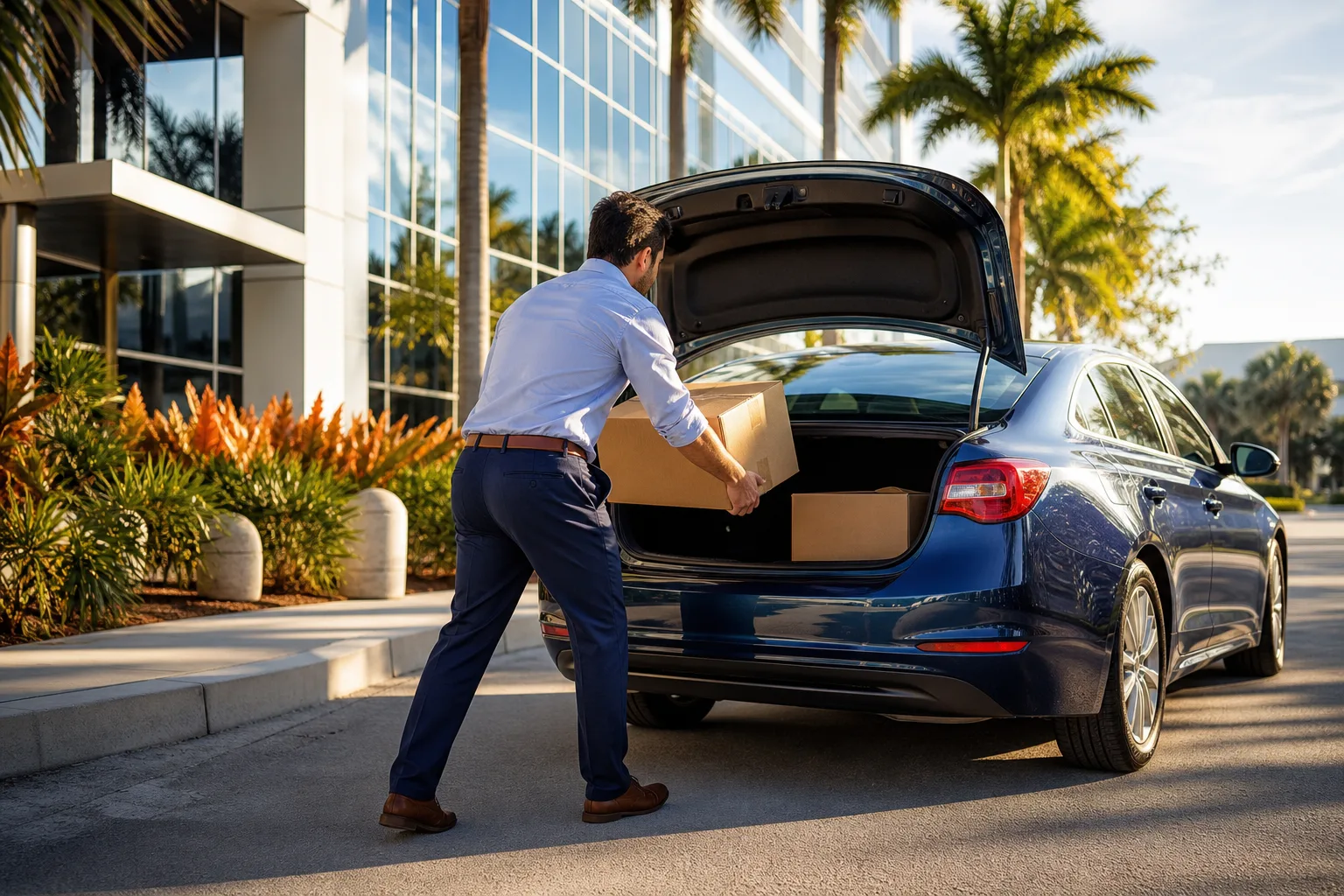
When an employee causes an accident in their own vehicle on a work errand, the claims sequence typically runs like this:
- The injured party's demand lands first against the employee's personal auto policy.
- If those limits are exhausted, or if the personal policy excludes business use, the demand pivots to the employer.
- If you have HNOA coverage, that policy responds on behalf of the business.
- If you have no HNOA coverage, the business faces uncovered exposure.
Personal auto policies in Florida are not required to cover commercial activity. Many standard personal policies contain business-use exclusions or sub-limits. Critically, Florida is a no-fault state that mandates only Personal Injury Protection (PIP) of $10,000 and Property Damage Liability (PDL) of $10,000, bodily injury liability coverage is not required for most private passenger vehicle owners and is optional. This means many employees may carry little or no bodily injury liability coverage at all, which makes the gap risk for your business even greater. The Florida Department of Highway Safety and Motor Vehicles publishes current state minimums.
Bottom line on sequencing: do not assume an employee's personal policy is sufficient protection for your business.
Step 3: Identify Which Business Trips Create the Greatest Exposure
Not all employee driving carries equal risk. Prioritize your review in this order:
| Trip Type | Scope of Employment? | Employer Exposure Level |
|---|---|---|
| Delivering products or documents to a client | Almost always yes | High |
| Attending a required off-site meeting | Generally yes | High |
| Running a supply errand during work hours | Generally yes | High |
| Commuting to and from the regular workplace | Generally no | Low |
| Personal errand during lunch, no work connection | Generally no | Low |
| Mixed trip: bank deposit then personal stop | Fact-specific | Medium to High |
Mixed-purpose trips are the gray zone. Courts look at which activity was primary. When in doubt, treat the trip as within scope when assessing your insurance need.
Protect the business you've built. Talk to our business team
Step 4: Obtain Hired and Non-Owned Auto Coverage
HNOA coverage is not a standalone line most people think about. It can appear in two places:
- As an endorsement added to a commercial auto policy or a business owners policy (BOP)
- As a standalone policy when the business owns no vehicles of its own
"Hired" auto refers to vehicles the business rents or borrows. "Non-owned" auto refers to vehicles employees own and use for business. HNOA pays on behalf of the business entity, not the employee. It sits in excess of the employee's personal auto coverage.
If your business owns vehicles, talk to your agent about whether HNOA is already included or needs to be added. If your business owns no vehicles and relies entirely on employee cars, a standalone HNOA policy is often essential. B & B Insurance Agency compares coverage and pricing from multiple carriers to find HNOA options that fit your business structure.
Step 5: Build a Written Driver and Vehicle Use Policy
Insurers and courts both respond better when a business has documented standards. A written policy should cover at minimum:
- Minimum personal auto liability limits employees must carry (many Florida businesses require $100,000/$300,000 or higher)
- A requirement that employees report their insurer and policy number annually
- Clear definition of which job tasks authorize personal vehicle use
- A prohibition on employees with serious driving violations using personal vehicles for work
- A reporting process when an accident occurs during a work trip
This does not eliminate liability, but it demonstrates due diligence, which matters in litigation and can influence insurer cooperation.
Step 6: Coordinate With Workers' Comp Coverage
If your employee is injured in the accident rather than causing injury to others, the analysis shifts to workers' compensation. Florida generally requires workers' comp for most employers with four or more employees. Construction employers face a stricter standard: under Florida law, construction businesses with one or more employees are required to carry workers' compensation coverage. An employee injured while making a work errand in their own car is typically a covered claim under workers' comp.
Workers' comp and your HNOA or commercial auto liability coverage serve different purposes and both matter. A gap in either creates a separate exposure. Review both with your agent at the same time. See workers' compensation for more on Florida requirements.
Common Mistakes
- Assuming the employee's personal policy covers everything. Business-use exclusions are real and enforceable in Florida.
- Skipping HNOA because the business owns no vehicles. That is exactly when HNOA matters most.
- Treating all commuting as scope of employment. Standard commuting is generally excluded, but adding a work errand to the commute can flip that result.
- Never collecting proof of personal auto insurance from employees. Without it, you have no early warning that an employee is uninsured or carrying minimum limits.
- Waiting until after a claim to review coverage. Florida's hurricane season deadline thinking applies here too: review your business auto exposures before you need them, not during a crisis.
Bottom Line
Florida's respondeat superior doctrine is straightforward in concept and costly in practice. If your employees run any work errand in a personal vehicle, your business carries real liability exposure that the employee's personal auto policy may not fully cover. A hired and non-owned auto endorsement or policy, combined with a written driver use policy and verified employee insurance minimums, is the standard way to manage that exposure.
To review your current commercial auto insurance or add HNOA coverage, contact B & B Insurance Agency. We compare coverage and pricing from multiple carriers and serve businesses throughout Lantana, West Palm Beach, and Palm Beach County.
Protect the business you've built.
General liability, commercial auto, workers' comp, bonds, and more, bundled and shopped across carriers for South Florida businesses.
Frequently asked questions
Does Florida's dangerous instrumentality doctrine apply when an employee drives their own car for work?
Generally not in the same way it applies to vehicle owners. Because the employee owns the car, dangerous instrumentality exposure falls on the employee as owner, not the employer. However, the employer can still face liability under respondeat superior if the employee was acting within the scope of employment at the time of the accident.
Is HNOA coverage required by Florida law for businesses?
Florida does not mandate hired and non-owned auto coverage, but the absence of it leaves a business financially exposed when an employee causes an accident in a personal vehicle on a work errand. It is a voluntary but strongly advisable coverage for most Florida businesses whose employees drive personal cars for any work purpose.
What minimum personal auto liability limits should I require my employees to carry?
Florida's statutory minimums are low relative to serious accident costs. Many Florida businesses contractually require employees who drive personal vehicles for work to carry at least $100,000 per person and $300,000 per accident in bodily injury liability, though the right threshold depends on the nature of the work. Consult your insurance agent to determine what makes sense for your specific operation.
Does a sole proprietor or single-member LLC with no employees need HNOA coverage?
If the owner is the only driver and uses a personal vehicle for business, the question is whether the personal auto policy covers business use, since many do not for commercial activity. A business-use endorsement on the personal auto policy or a commercial auto policy may be more appropriate than HNOA in that scenario. An independent agent can review the actual policy language to identify any gaps.
This article is general information, not legal or financial advice. Coverage depends on the terms, conditions, and exclusions of your specific policy, so talk with a licensed insurance agent about your situation.
Related Coverage from B & B
Have a question about this topic?
Our experienced agents are happy to help — no pressure, just straight answers.


