
Related coverage: Boat Insurance
TL;DR: Agreed value locks in a specific dollar amount you collect after a total loss with no depreciation applied. Stated value sets a ceiling but lets the insurer pay actual cash value instead if that figure is lower. For most Florida boat owners, the choice directly affects how much check you receive if your vessel is totaled.
At a Glance
| Feature | Agreed Value | Stated Value |
|---|---|---|
| Payout on total loss | Full agreed amount, no depreciation | Lesser of stated amount OR actual cash value |
| Depreciation at claim time | None | Applied by insurer |
| Premium | Generally higher | Generally lower |
| Best for | Boats holding value well, newer vessels | Older boats where ACV and stated value are close |
| Surprise risk at claim time | Low | Higher |
What "Agreed Value" Actually Means
When you and your insurer agree on a value at the start of the policy, that number is locked. If your boat is declared a total loss, the carrier pays that agreed amount in full, minus your deductible. Depreciation is not applied.
This matters a lot in South Florida. Salt air, UV exposure, and heavy seasonal use all wear on a vessel, but they also make replacement costs unpredictable. Knowing exactly what you will collect removes a major variable.
Agreed value is common on newer boats, high-end center consoles, and vessels where the owner has invested in upgrades. The insurer typically requires a recent survey or purchase documentation to establish the agreed figure.
What "Stated Value" Actually Means
Stated value sets the maximum the insurer will pay, not the guaranteed amount. At claim time, most stated value policies pay the lesser of the stated amount or the actual cash value (ACV) of the boat on the date of loss.
Actual cash value is roughly replacement cost minus depreciation. A five-year-old 24-foot center console that you stated at $60,000 may have an ACV the insurer calculates at $38,000 after accounting for age, condition, and market data. That is the number on your check, not $60,000.
The Insurance Information Institute notes that actual cash value settlements account for depreciation and are a common source of coverage gaps boat owners discover only after a loss.
The Dollar Gap: A Hypothetical Example
Here is a clearly labelled hypothetical to show how the two approaches play out.
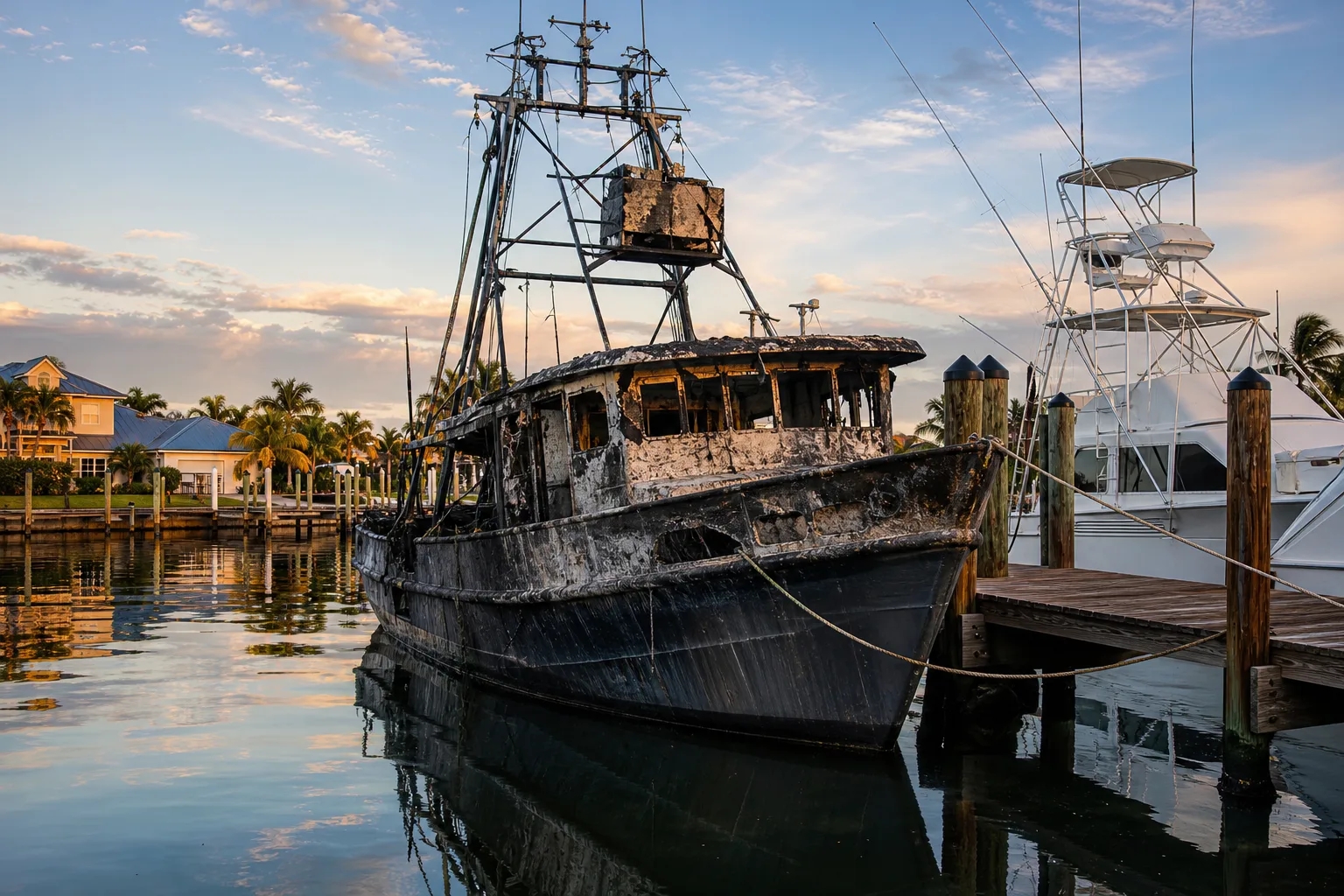
Scenario: You insure a 2020 offshore fishing boat. Purchase price was $75,000. Three years later a fire destroys it at the dock.
- Agreed value policy at $72,000: You collect $72,000 minus your deductible. No further negotiation.
- Stated value policy with ceiling of $72,000: The insurer calculates ACV at $52,000 based on market depreciation. You collect $52,000 minus your deductible.
- Potential gap: $20,000 out of pocket before you can replace the boat.
That $20,000 gap is not a penalty. It is simply how stated value policies are designed. The lower premium reflects that reduced payout exposure for the insurer.
Cover your boat, yacht, or jet ski the right way. Get a boat quote
Why Florida's Environment Makes This Decision Bigger
Florida boats depreciate faster in some categories because of continuous exposure to sun, salt, and humidity. That accelerated physical depreciation can widen the gap between your stated ceiling and the ACV the insurer assigns at claim time.
At the same time, certain popular boat categories, like well-maintained center consoles and sportfish vessels, hold resale value better than the insurer's depreciation schedule might reflect. An agreed value policy protects you when market value tracks close to or above your insured amount.
If your boat sits in the water year-round or is used heavily in intracoastal or offshore conditions around Palm Beach County, ask your agent whether the carrier's ACV formula accounts for regional market data or uses a national average.
When Stated Value Can Make Sense
Stated value is not automatically the wrong choice. Consider it when:
- The boat is older and its market value genuinely aligns with what an insurer would calculate as ACV.
- You are insuring a vessel you plan to sell or replace within a year or two.
- Budget is a constraint and you have savings that could cover a moderate depreciation gap.
The closer the ACV and stated value are to each other, the smaller your risk of a shortfall.
Questions to Ask Before You Choose
Use this diagnostic before committing to either option:
- What is the current market value of my boat? Check NADA Guides or recent comparable sales, not just what you paid.
- Does my carrier use a national or regional ACV formula? Regional data is more accurate for South Florida vessels.
- How old is the boat and how fast is it depreciating in my use category? A heavily used vessel in saltwater ages faster on paper.
- What is the premium difference between agreed and stated value? Compare that annual difference to the potential payout gap.
- Has the boat been surveyed recently? A current marine survey supports an agreed value and can also reveal condition issues.
Verdict
Agreed value generally delivers more predictable protection and fewer claim-time surprises, especially for newer or well-maintained boats in South Florida's demanding environment. The higher premium buys certainty. Stated value can be appropriate for older boats where the ACV and ceiling are genuinely close, but buyers should understand they are accepting depreciation risk in exchange for a lower premium.
If you are unsure which applies to your current policy, read your declarations page carefully. The payout language will specify whether the settlement is the agreed amount or the lesser of stated value and ACV.
Get a boat insurance quote from B & B Insurance Agency to compare both options across multiple carriers. If you have questions about how your current policy handles a total loss, reach out directly and we will walk through the language with you.
Cover your boat, yacht, or jet ski the right way.
Florida marine coverage from an independent agency that lives on the water too. Tell us what you ride.
Frequently asked questions
Can I switch from a stated value to an agreed value policy mid-term?
Most insurers require an endorsement and a current marine survey to convert to agreed value coverage. It is usually easier to make the change at renewal. Ask your agent to request agreed value quotes when your policy is up for renewal so you can compare the premium difference side by side.
Does a marine survey affect which valuation method I can get?
Yes. Many carriers require a recent survey, often within three to five years, before they will offer an agreed value policy. A survey documents the boat's condition and helps both parties agree on a fair insured value. An outdated or missing survey may limit your options to stated value coverage.
What happens if my boat is only partially damaged, not a total loss?
Agreed value vs. stated value mainly affects total loss settlements. For partial losses, most policies pay the cost of repairs minus your deductible, regardless of which valuation method you chose. Depreciation on parts can still be a factor depending on your policy's repair language, so it is worth confirming with your insurer.
Is personal watercraft coverage handled the same way?
Jet skis and other personal watercraft can also be insured on agreed or actual cash value terms depending on the carrier. The same depreciation risk applies. You can explore options on the personal watercraft insurance page or contact B & B Insurance Agency for a comparison quote.
This article is general information, not legal or financial advice. Coverage depends on the terms, conditions, and exclusions of your specific policy, so talk with a licensed insurance agent about your situation.
Related Coverage from B & B
Have a question about this topic?
Our experienced agents are happy to help — no pressure, just straight answers.


