

Related coverage: Homeowners Insurance, Flood Insurance
TL;DR: A standard Florida homeowners policy does not cover flood damage, excludes most mold remediation beyond a small sublimit, caps sinkhole claims under certain conditions, limits coverage on detached structures, and often leaves your home-based business equipment unprotected. Knowing these gaps before a storm or pipe burst can save you from a very unpleasant surprise.
Why New Florida Owners Get Caught Off Guard
Buying a home in Palm Beach County is exciting. You sign stacks of paperwork, pick out paint colors, and somewhere in that blur you sign off on a homeowners policy. Most people assume it covers everything that can go wrong with a house.
It does not.
Florida's climate and geology create risks that standard HO-3 policies were simply never designed to cover fully. I have sat across from new homeowners in Lantana who were genuinely shocked to learn what their policy excluded, usually right after something went wrong. Let me walk you through the five gaps I see cause the most pain, so you can plug them before a claim.
1. Flood Damage Is Never Covered by Your Homeowners Policy
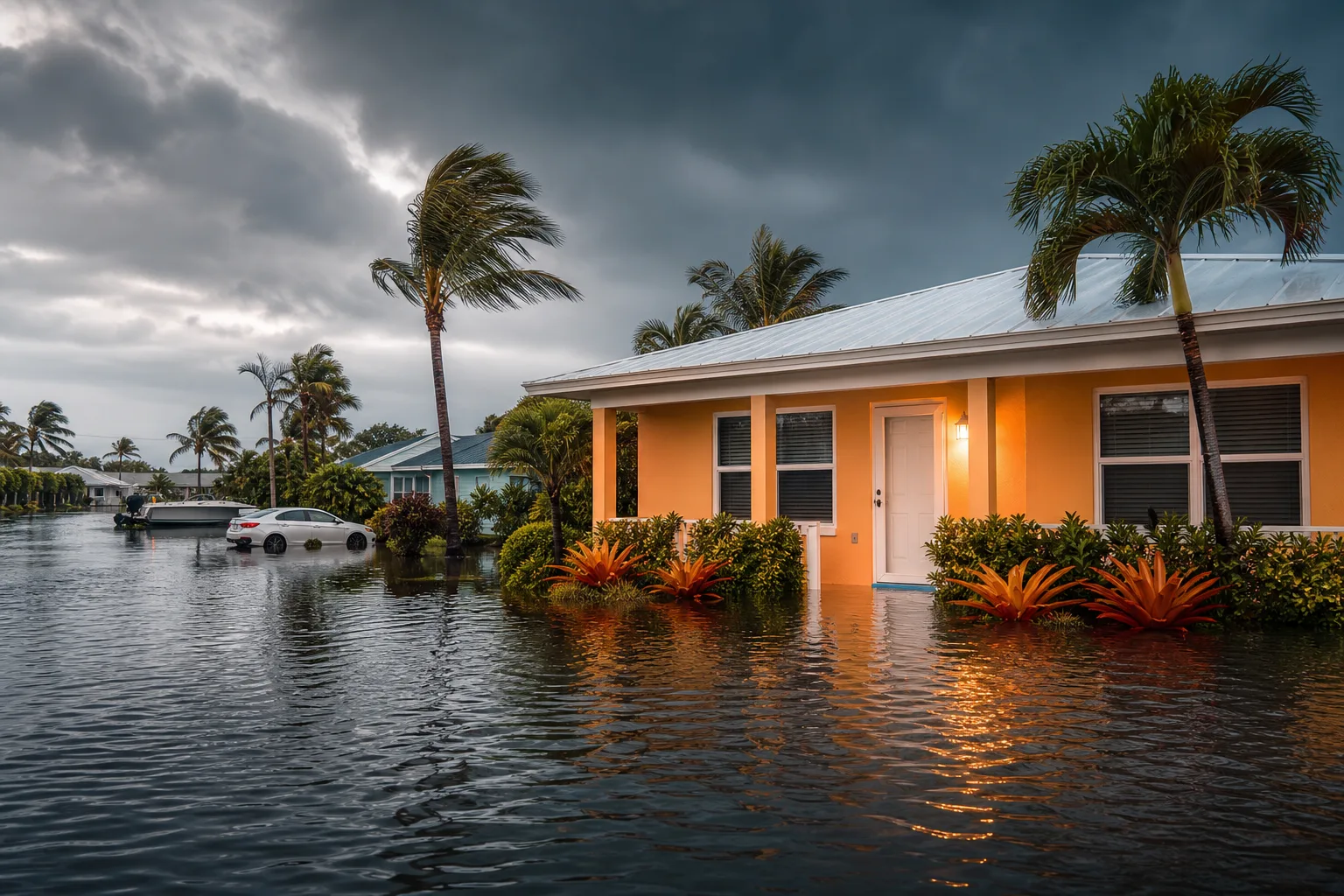
This is the big one. Every single standard homeowners policy in the country excludes flood damage. Every one. It does not matter how much you paid for your policy or how reputable your carrier is.
Flood coverage requires a completely separate policy, either through the National Flood Insurance Program (NFIP) or a private flood insurer. Here in Palm Beach County, where tropical storms can dump 10 to 15 inches of rain in a day and storm surge is a real threat for coastal and low-lying properties, this gap is not theoretical.
What most new owners do not realize: flood damage does not mean water pouring through a broken window during a hurricane. NFIP defines a flood as an inundation of normally dry land affecting two or more properties, or two or more acres. That means sheet flooding from heavy rain, overflow from a nearby canal, or storm surge all qualify as flood, not as wind-driven rain covered by your homeowners policy.
If your mortgage lender required you to buy flood insurance, great. But if you paid cash or your lender did not require it because your property falls outside a high-risk zone, you may still be very exposed. About 40 percent of NFIP flood claims come from outside designated high-risk flood zones, according to FEMA.
What I would tell my own family: Get a flood insurance quote regardless of what zone you are in. Premiums vary based on your property's flood risk profile, elevation, and coverage amount, get a quote specific to your address to find out what you'd pay.
2. Mold Remediation Is Subject to a Very Low Sublimit
Florida is humid. That is not news. But what surprises new homeowners is how little their policy pays when mold becomes a real problem.
Most standard HO-3 policies in Florida include mold coverage only if the mold was caused by a covered water loss, like a burst pipe. Even then, the payout is typically capped at a sublimit that can be as low as $10,000. Full mold remediation in a Florida home, especially after significant moisture intrusion, can run into the tens of thousands of dollars or more, depending on the extent of the damage.
Mold caused by long-term humidity, poor ventilation, or a slow leak you did not report promptly is almost always excluded entirely. Insurers call that a maintenance issue, and they have the fine print to back it up.
Florida's climate makes this gap more consequential than it would be in a drier state. One summer with a slow refrigerator line drip behind the wall and you can have a serious mold situation before you notice anything.
What to do: Ask your agent about a mold buyback endorsement, which raises the sublimit. Also, fix slow leaks immediately, document the repair, and notify your insurer if the leak caused visible damage. Prompt reporting protects your right to make a claim later.
Want a second look at your Florida homeowners coverage? Get a free home quote
3. Sinkhole Coverage Is Not the Same as Catastrophic Ground Cover Collapse
Florida has a unique geological exposure. The state sits on a limestone foundation that dissolves over time, creating sinkholes. This is common enough that Florida law requires insurers to offer sinkhole coverage, but the way it works trips up a lot of new owners.
Your standard policy almost certainly includes coverage for catastrophic ground cover collapse, which means a sudden, dramatic sinkhole that causes your structure to actually fall into the ground. That is the nightmare scenario.
But the far more common problem is subsidence, where the ground slowly settles and causes cracks in your foundation, walls, or driveway over months or years. That is sinkhole activity, and it requires separate sinkhole coverage, which carriers can charge separately for and which many homeowners unknowingly decline to save money.
According to the Florida Department of Financial Services, insurers are required to offer sinkhole loss coverage, but they are not required to include it automatically in your base policy. You have to ask and pay for it.
If you are in central or western Palm Beach County, or in areas with older fill or disturbed soil, I would take sinkhole coverage seriously. A claim involving foundation damage can easily exceed $100,000.
4. Your Detached Structures Coverage May Be Too Low
Most HO-3 policies cover detached structures, like a fence, detached garage, shed, or pergola, at 10 percent of your dwelling coverage limit. That sounds reasonable until you actually do the math.
Say your home is insured for $350,000. That means your detached structures are covered for $35,000, total. Now consider that a new two-car detached garage in South Florida can cost $40,000 to $70,000 or more, depending on materials and construction, check current local contractor estimates for your area. A hurricane takes it down, and you are short.
This gap gets worse if you have added structures since you bought the policy and did not update your coverage. A new outdoor kitchen, a she-shed, a large fence, a generator enclosure. These all count toward that 10 percent limit, and that bucket fills up fast in Florida where outdoor living spaces are common.
What I would tell my own family: Walk your property once a year, make a list of every detached structure, and call your agent to make sure the 10 percent limit still makes sense. If it does not, ask about increasing Other Structures coverage. It is usually inexpensive to raise.
And if you have a golf cart stored in one of those structures, remember that the cart itself is generally not covered under your homeowners policy at all. You would need a separate golf cart insurance policy for that.
5. Home-Based Business Property and Liability Are Largely Excluded
This one hits close to home for a lot of Palm Beach County residents who work remotely or run a small business out of their house. Your homeowners policy is designed to cover personal use of your home, not commercial activity.
Here is what that means in practice:
Business personal property is typically limited to about $2,500 under a standard HO-3 policy. If you have a home office with a $3,000 laptop, a second monitor, a professional camera, or specialized equipment, you are likely underinsured the moment something is stolen or damaged.
Business liability is almost entirely excluded. If a client visits your home for a meeting and slips on your front steps, your homeowners liability will likely not cover the resulting lawsuit because the injury happened in connection with a business activity.
This gap is not hypothetical. It comes up in claims more than people expect, and it can be expensive. A homeowners endorsement for a home-based business can add meaningful protection at a relatively low cost, or you may need a separate business owner's policy depending on your operation.
We cover this territory in more detail elsewhere, but if you run any kind of business from home, it is worth a conversation with your agent before something happens.
If you have employees, even part-time, you may also need workers' compensation. Check out workers' comp to understand the Florida requirements.
Bottom Line
A standard homeowners insurance policy is a solid foundation, but it was not built to cover every Florida-specific risk on its own. The five gaps above, flood, mold limits, sinkhole activity, low detached structures limits, and home business exclusions, are the ones I see catch new owners off guard most often.
The good news is that most of them are fixable. Riders, endorsements, and separate policies exist to close each one, and as an independent agency, B & B Insurance Agency compares coverage and pricing from multiple carriers to find the right combination for your situation and budget.
If you recently bought a home in Lantana, West Palm Beach, or anywhere in Palm Beach County, reach out for a free policy review. We will go line by line and tell you exactly where you stand. Get in touch with us today before the next storm season reminds you the hard way.
Want a second look at your Florida homeowners coverage?
B & B Insurance compares coverage and pricing from multiple carriers, and we know Florida wind and flood rules cold.
Frequently asked questions
Does a standard Florida homeowners policy cover any water damage at all?
Yes, but only certain types. Sudden and accidental water damage, like a burst pipe or an appliance that suddenly fails, is typically covered. What is excluded is flood damage from external sources, gradual leaks you knew about and did not fix, and water backup from sewers or drains unless you have added that endorsement separately.
How much does flood insurance cost for a home in Palm Beach County?
It depends on your property's flood zone, elevation, and the coverage amount you choose. Homes in low-to-moderate risk zones often pay a few hundred dollars per year for NFIP coverage, while properties in high-risk zones pay more. Private flood market options can sometimes offer competitive pricing or broader coverage. The best way to find out is to get a quote specific to your address.
Is sinkhole coverage required in Florida?
Florida law requires insurers to offer sinkhole loss coverage, but it is not automatically included in every policy. Your base policy will include catastrophic ground cover collapse, which is a very narrow definition. To cover the more common scenario of gradual ground subsidence causing structural damage, you need to specifically elect and pay for sinkhole coverage.
What is the best way to cover my home office equipment under a homeowners policy?
First, check your current policy's business personal property sublimit, which is often around $2,500. If that is not enough, ask your agent about a home business endorsement that raises the limit. For larger operations or if you have clients visiting your home, a separate business owner's policy may be more appropriate and can also include liability coverage that a homeowners policy will not provide.
Do detached structures like a shed or fence require a separate insurance policy?
No, they are covered under your standard homeowners policy under the Other Structures section, typically at 10 percent of your dwelling limit. The problem is that 10 percent may not be enough if you have multiple structures or high-value ones like a detached garage. Talk to your agent about whether that limit needs to be increased, and remember that personal vehicles and equipment like golf carts stored in those structures need their own coverage.
Related Coverage from B & B
Have a question about this topic?
Our experienced agents are happy to help — no pressure, just straight answers.


