TL;DR: A Florida house policy (HO-3) must cover the entire dwelling from the roof down. A condo policy (HO-6) covers only your unit interior and personal property, because the condo association's master policy handles the exterior shell. The critical variable is your association's master policy language: "bare walls in" vs. "all-in" changes how much interior coverage you actually need.
At a Glance
| Factor | HO-3 (House) | HO-6 (Condo) |
|---|---|---|
| Structure insured | Entire dwelling | Unit interior only |
| Exterior/roof | Your policy | Association master policy |
| Dwelling limit | Full replacement cost of the house | Enough to cover interior finishes + master policy gap |
| Loss assessment coverage | Not applicable | Critical; often underloaded |
| Association deductible exposure | None | Potentially tens of thousands |
| Flood coverage | Separate NFIP or private policy | Separate NFIP or private policy (both need it) |
What an HO-3 House Policy Covers
When you own a freestanding home, the insurer takes on the full structure: roof, walls, foundation, attached garage, built-in appliances, and all permanently attached fixtures. Your dwelling limit (Coverage A) should equal the home's estimated replacement cost, not its market value.
In South Florida, where construction costs run high and building-code upgrades after a loss can add 20-30% to a rebuild, an underinsured Coverage A is a common problem. Florida's building code requires current-code compliance on repairs above a certain threshold, which is why ordinance-or-law coverage matters on an HO-3. See homeowners insurance for more on how that works.
Other standard HO-3 coverages:
- Coverage B (other structures): fences, detached garage, sheds, typically 10% of Coverage A
- Coverage C (personal property): furniture, electronics, clothing
- Coverage D (loss of use): temporary housing while repairs happen
What an HO-6 Condo Policy Covers
An HO-6 is designed around a shared-ownership reality. The condominium association owns and insures the building shell. Your policy picks up where the master policy stops.
That boundary is defined by two phrases you must find in your association's governing documents:
- "Bare walls in" (also called "studs out" for the master policy): The association covers only the unfinished walls, ceiling, and floor slabs. You must insure everything from the drywall inward, including flooring, cabinetry, countertops, and fixtures.
- "All-in" (or "single entity"): The association covers original installed fixtures and finishes. You still need to cover upgrades you made above the original spec, plus your personal property.
Under a bare-walls-in master policy, your HO-6 Coverage A dwelling limit needs to be set high enough to rebuild the entire interior of your unit. That is a substantial number in a Palm Beach County condo with tile floors, updated kitchens, and hurricane-impact windows inside the unit frame.
Loss Assessment: The Coverage Most Condo Owners Underestimate
This is where condo owners face a risk that house owners simply do not. When a hurricane damages common areas, the association may assess every unit owner for a share of the repair bill or the master policy deductible.
Florida law (Florida Statutes § 718.111) governs condo association operations, and association deductibles on master policies can run 2-5% of the insured building value. On a large complex, that deductible alone can produce individual unit assessments of $10,000 or more.
HO-6 policies include a loss assessment limit, but the default is often $1,000. That number is usually not sufficient. Most insurers allow you to increase it to $50,000 or more for a modest premium difference. Check your current limit.
Paying too much for Florida homeowners insurance? Get a free home quote
Flood Coverage: Both Policy Types Have the Same Gap
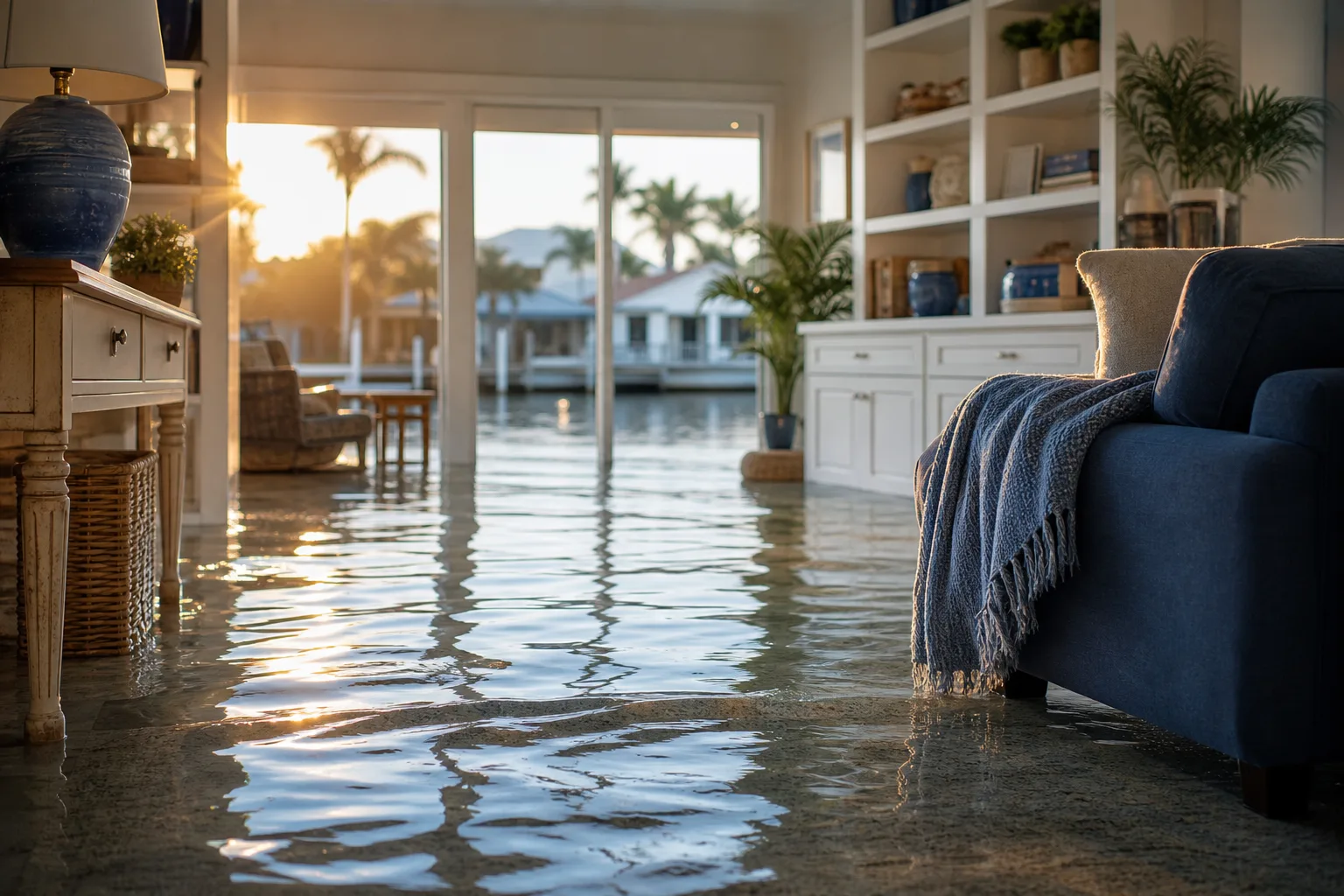
Neither an HO-3 nor an HO-6 covers rising water from a storm surge, heavy rain, or overflowing waterways. That gap is identical regardless of property type.
For a condo unit, the NFIP's Residential Condominium Building Association Policy (RCBAP) covers the building, but unit owners still need a separate contents-only flood policy to cover personal property within the unit. Flood damage to your flooring, furniture, and electronics will not be paid by the RCBAP or by your HO-6.
For houses, a separate flood policy covers the structure and optionally contents. See flood insurance for how to evaluate your flood zone and coverage options.
Liability Limits: A Difference in Context
Both policy types include personal liability (Coverage E), typically starting at $100,000. The practical difference is context.
A house owner faces liability exposure from their full lot: pool, driveway, sidewalk. A condo owner's unit is smaller, but guests can still be injured inside, and water damage you cause to a neighbor's unit creates a liability situation HO-6 covers. Neither policy covers common areas, which fall under the association's commercial liability policy.
Decision Table: Setting Your Condo Coverage Limits Correctly
Use this sequence before you set or renew an HO-6:
- Obtain the association's master policy declarations page. Confirm the master policy type: bare walls in or all-in.
- Estimate interior replacement cost. For bare-walls-in, price out flooring, drywall, cabinetry, fixtures, and installed appliances per square foot with a local contractor or insurer's estimating tool.
- Read the association deductible. Find the windstorm deductible percentage, multiply it against the building's total insured value, then divide by number of units for a rough worst-case assessment per unit. Set your loss assessment limit at or above that figure.
- Check your personal property limit. Conduct a home inventory. The Insurance Information Institute provides a free home inventory tool to document belongings.
- Confirm flood coverage separately. Determine your flood zone at FEMA's Flood Map Service Center and decide whether contents-only or full flood coverage fits your situation.
Verdict
The biggest mistake Florida condo owners make is assuming the association has everything covered. The master policy handles the shell. Your HO-6 handles your interior, your belongings, and, critically, your share of any assessment when common property is damaged.
The biggest mistake house owners make is underestimating Coverage A replacement cost, especially after several years of construction cost inflation in South Florida.
Both property types also need a separate flood policy. Neither standard form covers rising water.
If you are a condo owner in Palm Beach County and want someone to review your association's master policy against your current HO-6 limits, the team at B & B Insurance Agency can compare your options across multiple carriers and help you set loss assessment coverage at a defensible number before hurricane season arrives.
Paying too much for Florida homeowners insurance?
B & B Insurance shops multiple carriers to find you the right coverage at the right price — and we know Florida wind and flood rules cold.
Frequently asked questions
Does my HO-6 condo policy cover hurricane wind damage to my roof?
No. The roof is part of the building shell, which is the association's master policy responsibility. Your HO-6 covers your unit interior. If the roof damage leads to water intrusion that destroys your flooring or cabinetry, your HO-6 dwelling coverage would apply to those interior repairs, subject to your deductible and the master policy type.
If my neighbor's burst pipe floods my condo unit, whose policy pays?
Your own HO-6 personal property and dwelling coverage typically responds first for your unit's damage. Your insurer may then pursue subrogation against your neighbor's liability coverage. Having adequate Coverage A on your HO-6 is important precisely because water-intrusion losses from other units are common in Florida condos.
Is loss assessment coverage the same as liability coverage on an HO-6?
No, they are separate coverages. Loss assessment pays your share of a common-area loss or master policy deductible that the association passes on to unit owners. Liability coverage pays if a guest is injured inside your unit or if you accidentally cause property damage to another unit. Both are included in a standard HO-6, but the limits are set independently.
Can I get replacement cost on my personal property under an HO-6?
Yes. Most HO-6 policies offer an endorsement for replacement cost value on personal property rather than actual cash value, which deducts depreciation. In Florida, where humidity and storm losses can affect electronics, appliances, and furniture, the difference between the two settlement methods on a contents claim can be significant.
This article is general information, not legal or financial advice. Coverage depends on the terms, conditions, and exclusions of your specific policy, so talk with a licensed insurance agent about your situation.
Have a question about this topic?
Our experienced agents are happy to help — no pressure, just straight answers.