TL;DR
A standard property and general liability policy covers the obvious stuff, your building, your inventory, and slip-and-fall claims. It often misses the coverages that protect your cash flow and reputation after something goes wrong. Below are 5 gaps retail owners in Lantana, West Palm Beach, and across Palm Beach County commonly carry without realizing it.
Why this matters for a retail shop
Retail is a cash-flow business. A closed storefront doesn't just cost you repair bills, it costs you every day of lost sales while the doors are shut. Florida's hurricane season and afternoon storm pattern make interruption risk higher here than in a lot of states. The coverages below aren't exotic add-ons. They're the ones that get skipped because nobody asks about them until there's a claim.
1. Business income (interruption) coverage
The risk it prevents: your building is damaged, you're closed for weeks, and rent, payroll, and loan payments keep coming even though sales stopped.
A basic commercial property policy pays to repair or replace the building and damaged stock. It generally does not pay you for the sales you lose while repairs happen, unless you've added business income coverage. For a boutique or shop that depends on foot traffic, a month or two of closure after a storm or fire can be more financially damaging than the property damage itself.
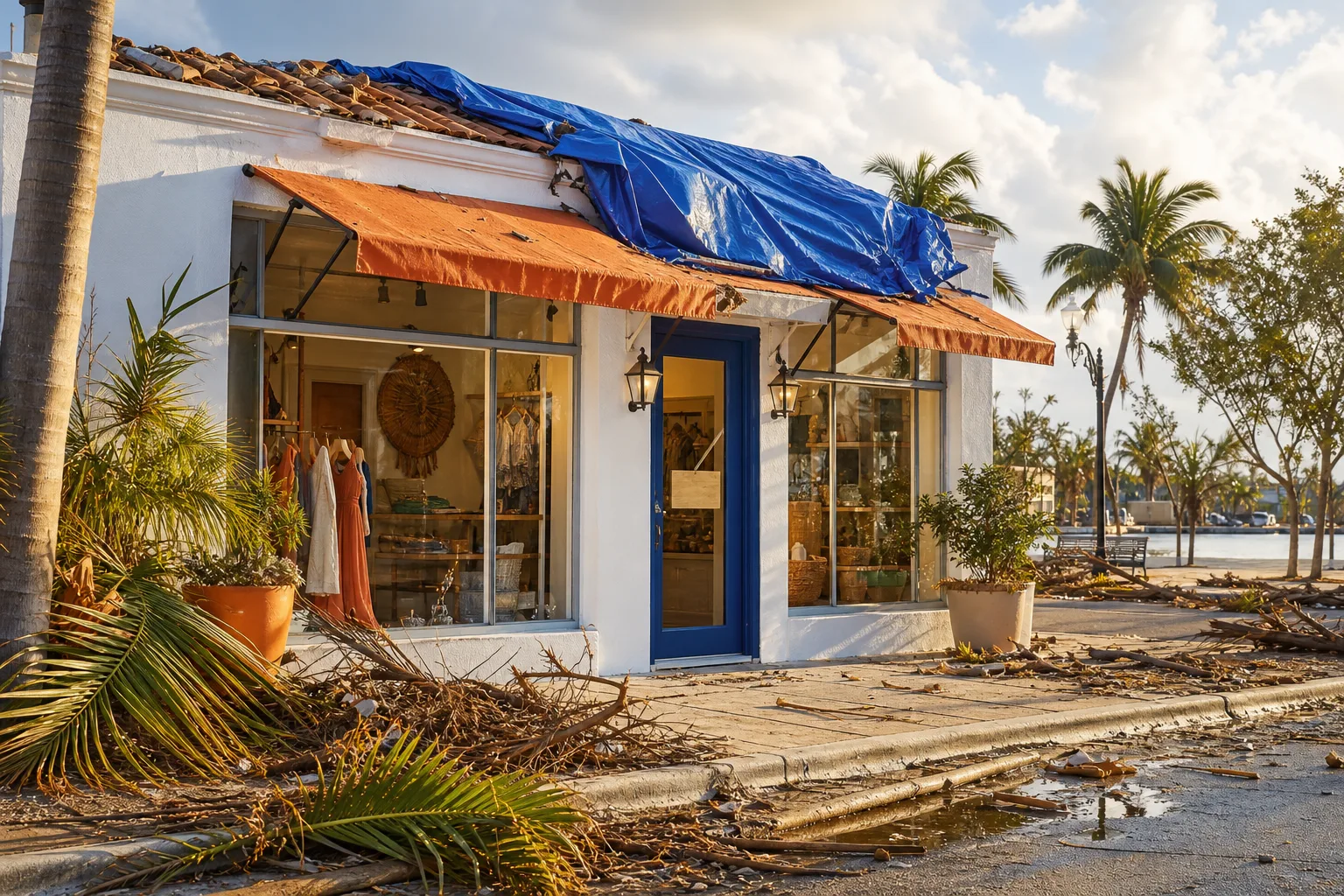
Worked example: a gift shop in downtown Lake Worth Beach takes wind and water damage during a tropical storm. Repairs take seven weeks. Business income coverage can reimburse lost net income and continuing fixed expenses during that closure, within the policy's limits and waiting period. Without it, the owner absorbs that gap out of pocket.
2. Equipment breakdown coverage
The risk it prevents: your walk-in cooler, POS system, or HVAC unit fails from mechanical or electrical breakdown, not from fire or a covered peril, and standard property insurance doesn't respond.
Many retail property policies are written on a peril basis (fire, wind, theft, etc.) and exclude failures caused by electrical arcing, motor burnout, or boiler and pressure-vessel issues. A consignment or specialty food shop that loses refrigeration to a compressor failure can lose entire categories of inventory, and that loss may fall outside a standard policy unless equipment breakdown coverage is added.
3. Spoilage and inventory coverage tailored to your stock
The risk it prevents: perishable or climate-sensitive inventory is ruined by a power outage, refrigeration failure, or humidity intrusion, and the payout under a generic inventory limit doesn't reflect what you actually lost.
Florida's grid sees storm-related outages most hurricane seasons. A pharmacy, florist, or specialty food retailer with temperature-sensitive stock should confirm the policy either includes spoilage coverage or has an endorsement for it, and that the inventory limit is based on current stock levels, not what was declared when the policy was first written.
Protect the business you've built. Talk to our business team
4. Cyber liability and point-of-sale data coverage
The risk it prevents: a payment system breach, ransomware incident, or employee error exposes customer card data or shuts down your POS, and general liability doesn't cover the notification, legal, and recovery costs.
Any retailer running card payments, a loyalty app, or customer email lists holds data that can trigger notification and liability costs under Florida law if it's breached. Florida's data breach notification statute spells out timelines and obligations for businesses holding personal information (Florida Statute 501.171). General liability policies typically exclude data breach response costs, which is why cyber coverage is sold separately.
5. Hired and non-owned auto coverage
The risk it prevents: an employee uses their own car or a rental to make a bank run, deliver inventory, or pick up supplies, gets into an accident, and your business has no auto coverage in place because you don't own a company vehicle.
Retail owners assume they don't need commercial auto coverage because the shop doesn't own a delivery truck. But if staff ever drive their personal vehicles or a rented one for business errands, a hired and non-owned auto endorsement closes that gap. Without it, a claim from that accident can land directly on the business with no coverage responding.
How to check your own policy
- Pull your current policy declarations page and look for "business income," "equipment breakdown," and "spoilage" as line items, not just assumed inclusions.
- Ask whether your inventory limit reflects your current stock value, especially after a busy season or a change in product mix.
- Confirm whether cyber or data breach coverage exists anywhere in your policy stack, it's often absent entirely.
- List every situation where an employee drives any vehicle for business purposes, then confirm that's covered.
- If two or more of these are unclear, it's worth a conversation with an agent rather than guessing.
When to DIY vs. call an agent
Reviewing your own declarations page for the five items above is something any owner can do in twenty minutes. Deciding on limits, waiting periods for business income, or whether spoilage needs a separate endorsement is where an independent agent earns their keep, because the right answer depends on your specific inventory, location, and how you operate day to day.
Bottom line
A retail policy built only around the building and basic liability leaves real gaps in income protection, equipment, inventory, data, and auto exposure. None of these five are unusual or expensive to consider, they're just easy to miss without someone walking through the policy line by line. B & B Insurance Agency has shopped commercial coverage for South Florida business owners since 1998, and can review what you have against what your shop actually needs. Start with general liability coverage as your foundation, then ask about commercial property and commercial auto for the gaps above, or get a free quote and we'll walk through it together.
Protect the business you've built.
General liability, commercial auto, workers' comp, bonds, and more — bundled and shopped across carriers for South Florida businesses.
Frequently asked questions
Does my general liability policy cover a data breach at my retail store?
Usually not. General liability is built around bodily injury and property damage claims from third parties, not data breach notification or recovery costs. Cyber liability is typically a separate policy or endorsement.
How much business income coverage does a small retail shop need?
It depends on your fixed monthly expenses (rent, payroll, loans) and how long a realistic repair or rebuild would take after a covered loss. An agent can help estimate this based on your lease terms and typical contractor timelines in your area.
Is equipment breakdown coverage only for restaurants with big kitchens?
No. Any retailer with refrigeration, HVAC, POS servers, or specialized equipment can benefit, since mechanical and electrical failures are commonly excluded from standard property policies regardless of business type.
What counts as a non-owned vehicle for hired and non-owned auto coverage?
It generally includes any vehicle the business doesn't own but that's used for business purposes, such as an employee's personal car for a supply run or a rental car used while traveling for the business.
This article is general information, not legal or financial advice. Coverage depends on the terms, conditions, and exclusions of your specific policy, so talk with a licensed insurance agent about your situation.
Have a question about this topic?
Our experienced agents are happy to help — no pressure, just straight answers.