

Related coverage: Workers' Compensation, Auto Insurance, General Liability Insurance
TL;DR: Workers' comp pays your driver's medical costs and partial lost wages when they are hurt on the job, regardless of fault. It does not cover property damage or injuries to third parties. A separate commercial auto policy handles liability to others. Florida employers in the construction industry with one or more employees, and non-construction employers with four or more employees, are generally required to carry workers' comp. (Florida Division of Workers' Compensation)
What You Need
Before reading further, confirm you have these in place or know the gap:
- Workers' compensation policy covering employees who drive on the job
- Commercial auto liability policy on every vehicle used for deliveries
- Hired and non-owned auto (HNOA) coverage if drivers use personal vehicles for deliveries
- Clear documentation of which employees make deliveries and how often
Missing any one of these creates a coverage gap that comes out of your pocket.
Step 1: Identify Which Policy Applies to Which Injury
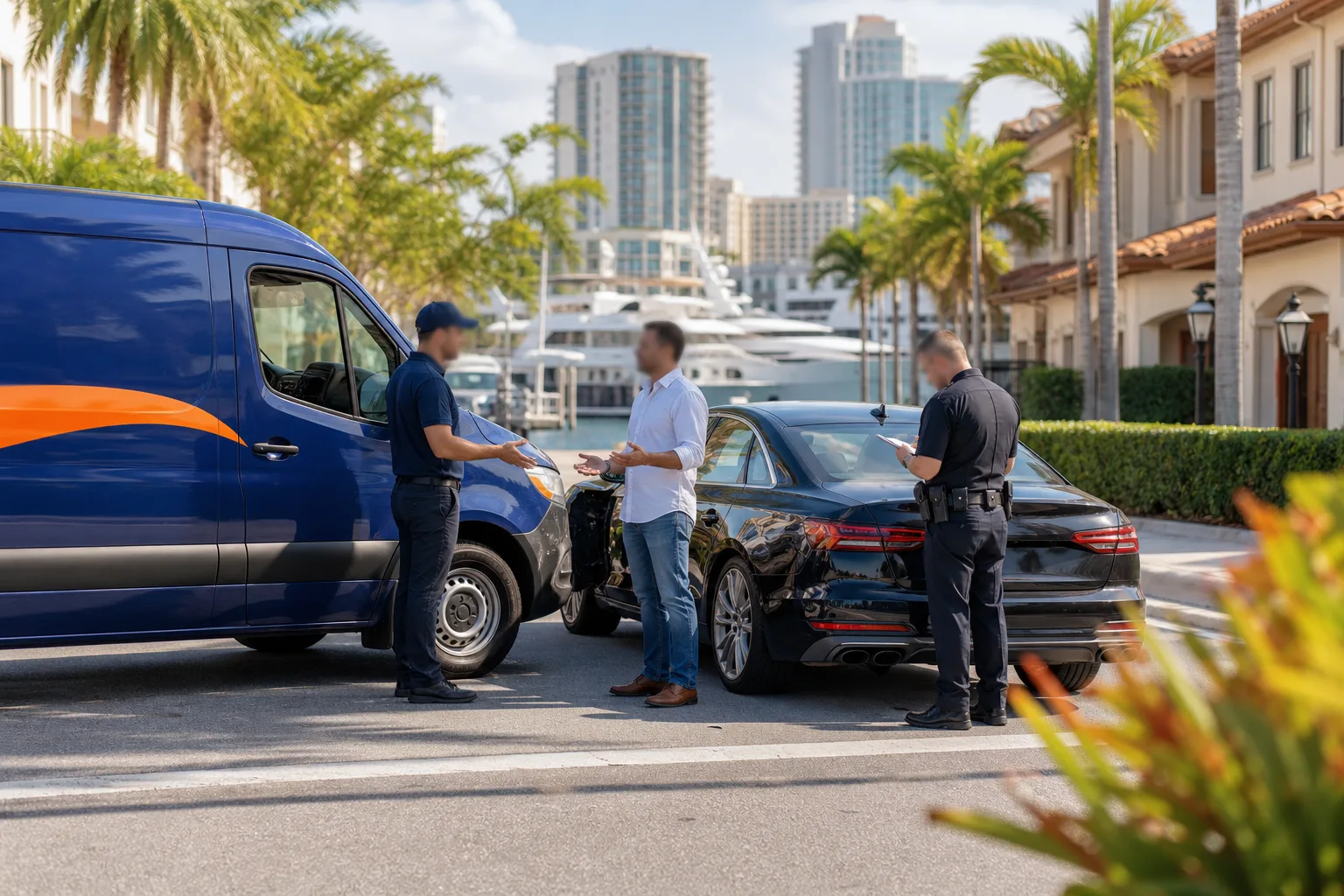
An accident involving a delivery driver produces at least two categories of potential harm.
Your driver's injuries and lost wages: Workers' comp is the exclusive remedy here in most cases. Florida's workers' comp system pays medical treatment, a portion of lost wages (typically 66.67% of average weekly wage up to a statutory cap), and permanent impairment benefits if applicable. (Florida Statutes Chapter 440)
The other driver's injuries and vehicle damage: Workers' comp pays nothing toward third-party claims. Commercial auto liability covers bodily injury and property damage to others when your driver is at fault.
A quick decision table:
| Harm | Policy that responds |
|---|---|
| Driver's medical bills | Workers' comp |
| Driver's lost wages | Workers' comp |
| Driver's permanent disability | Workers' comp |
| Other party's medical bills | Commercial auto liability |
| Other party's vehicle or property damage | Commercial auto liability |
| Your vehicle repair | Commercial auto physical damage (comp/collision) |
Step 2: Understand the "Course and Scope" Rule
Workers' comp only applies when the injury happens while the employee is acting within the course and scope of employment.
For a delivery driver this is usually straightforward: driving from your business to a customer's address is clearly on the clock. Edge cases matter, though.
- Detour: Driver takes a significant personal side trip before the delivery. That detour may fall outside coverage until they return to the delivery route.
- Commuting: Standard commute from home to work is generally NOT covered. The driver is covered once they begin the first delivery-related task.
- Personal errands on company time: A short stop for coffee is often still covered. A 30-minute personal errand mid-route may not be.
Document routes, dispatch records, and GPS logs. If a claim is disputed, that documentation determines whether workers' comp responds.
Step 3: Check Whether Commercial Auto Covers the Vehicle in Use
Workers' comp does not care which vehicle the driver used. Commercial auto liability very much does.
- Business-owned vehicle: A commercial auto policy on that vehicle responds.
- Driver's personal vehicle: Your commercial auto policy does NOT automatically cover a personal vehicle. You need hired and non-owned auto (HNOA) coverage added to your commercial auto or general liability policy. Without it, the driver's personal auto policy is the only defense, and many personal policies exclude delivery driving above certain thresholds.
- Rented or leased vehicle: Hired auto coverage handles this. Confirm it is endorsed onto your policy.
This is the most common gap small business owners discover after a claim, not before.
Protect the business you've built. Talk to our business team
Step 4: Know What Workers' Comp Excludes
Workers' comp in Florida does not pay:
- Pain and suffering for the injured worker (the trade-off for the no-fault benefit)
- Third-party property damage or medical bills
- Claims for workers classified as independent contractors (though misclassification is a serious risk; the IRS 20-factor test and Florida standards may treat a driver as an employee regardless of contract language)
- Intentional acts by the employee
If your delivery drivers are classified as 1099 contractors, review that classification carefully. Florida courts and regulators have reclassified workers in delivery roles, exposing employers to uncovered claims.
Step 5: Handle a Claim Correctly
- Secure the scene and get medical help. The driver should seek authorized care through your workers' comp carrier, not a personal physician, or the claim may be denied.
- Report the claim to your workers' comp carrier immediately. Florida requires employers to report injuries within 7 days of knowledge. Late reporting can result in penalties.
- Report to your commercial auto carrier. Even if you think liability is minimal, notify the carrier. Failure to report promptly can jeopardize coverage.
- Preserve evidence. Photos, witness statements, GPS logs, delivery records.
- Do not direct the driver to use health insurance instead of workers' comp. This is a common mistake and potentially a violation of Florida workers' comp law.
Common Mistakes
Assuming workers' comp handles everything. It handles your driver's side of the injury equation only. The other party's attorney is sending a demand letter to your commercial auto carrier, not your workers' comp carrier.
Forgetting HNOA when drivers use personal cars. This is a real gap for small operations where employees run deliveries in their own vehicles.
Misclassifying drivers as contractors to skip workers' comp premiums. The savings are not real if a reclassification finding hits. Back premiums, penalties, and uninsured claims can far exceed what was saved.
Skipping medical direction. Telling an injured driver to "just see your own doctor" can void the workers' comp claim or create disputes about authorized treatment.
Bottom Line
A delivery driver accident triggers two separate coverage questions: what happens to your driver, and what happens to everyone else. Workers' comp answers the first. Commercial auto liability answers the second. If either policy is missing or the wrong vehicle is involved, your business absorbs that cost directly.
If you are not certain your workers' comp and commercial auto policies work together without gaps, that is worth a conversation. B & B Insurance Agency compares coverage and pricing from multiple carriers and can review both policies side by side. Start with a free quote or question here.
Protect the business you've built.
General liability, commercial auto, workers' comp, bonds, and more — bundled and shopped across carriers for South Florida businesses.
Frequently asked questions
Can a third party injured by my delivery driver sue me even if workers' comp is in place?
Yes. Workers' comp protects your employee from suing you for their own injuries, but it does not protect you from third-party claims. The other driver or property owner can pursue a liability claim against your business, which is why commercial auto liability coverage is essential.
What if my driver was partly at fault but also injured, does workers' comp still pay?
Yes. Florida workers' compensation is a no-fault system. Your driver's benefits are paid regardless of who caused the accident, as long as the injury occurred in the course and scope of employment. Fault only matters for the commercial auto liability portion of the claim.
Does workers' comp cover a delivery driver injured while loading or unloading, not while driving?
Generally yes. Loading and unloading a delivery vehicle is considered part of the job, so injuries during those tasks typically fall within the course and scope of employment. Document the activity at the time of injury to support the claim.
Are there Florida-specific workers' comp requirements I should know as a non-construction employer?
Non-construction employers in Florida must carry workers' comp once they have four or more employees, including part-time workers. Construction employers must cover one or more employees. The Florida Division of Workers' Compensation enforces compliance and can issue stop-work orders for non-compliant businesses.
This article is general information, not legal or financial advice. Coverage depends on the terms, conditions, and exclusions of your specific policy, so talk with a licensed insurance agent about your situation.
Related Coverage from B & B
Have a question about this topic?
Our experienced agents are happy to help — no pressure, just straight answers.


