

TL;DR
Florida requires PIP (Personal Injury Protection) on every auto policy, and it pays 80% of your medical bills up to $10,000, no matter who caused the crash. Medical Payments coverage (MedPay) is optional, but it can pick up the 20% PIP leaves behind and cover costs after PIP runs out. Here's what I'd tell my own family: don't assume PIP has you covered. It almost never covers everything.
At a glance
| PIP | MedPay | |
|---|---|---|
| Required in Florida? | Yes, minimum $10,000 | No, optional |
| Who it pays | You, regardless of fault | You, regardless of fault |
| What it pays | 80% of medical bills, 60% of lost wages | Up to 100% of medical bills, up to your chosen limit |
| Typical limits | $10,000 | $1,000 to $10,000, sometimes higher |
| Covers the 20% PIP doesn't pay? | No | Yes, often |
| Covers funeral costs? | Limited amount | Sometimes, check the policy |
| Stacks with health insurance? | Usually pays first | Can supplement after PIP |
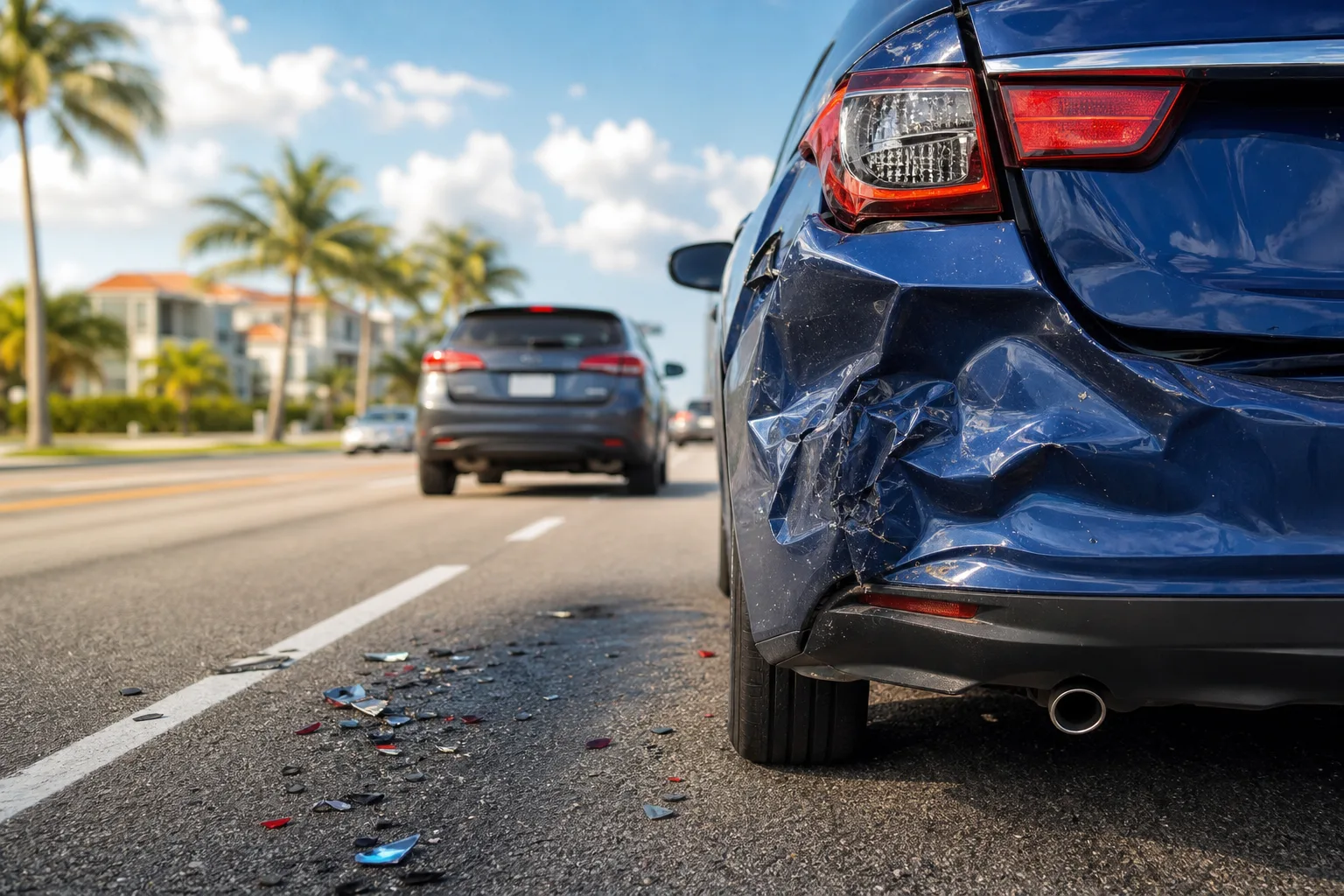
What PIP actually covers (and what it doesn't)
Florida is a no-fault state, which means your own auto insurance pays your medical bills after a crash, regardless of who caused it. That's PIP. The state requires at least $10,000 in PIP on every policy registered here.
Here's the part that trips people up. PIP doesn't pay 100% of your bills. It pays 80% of reasonable medical expenses and 60% of lost wages, up to that $10,000 cap. So if you rack up $10,000 in emergency room and follow-up bills, PIP is only going to cover $8,000 of it. You're on the hook for the other $2,000, unless something else steps in.
There's also a requirement that you seek initial treatment within 14 days of the accident, or PIP benefits can be denied entirely. This catches a lot of people off guard. You might feel fine after a fender-bender, skip the ER, and then wake up four days later with serious neck pain, but if you wait past that 14-day window to see a doctor, your insurer has legal grounds to deny the claim. It doesn't matter that you were genuinely injured.
And if your injury isn't classified as an "emergency medical condition" (EMC) by a licensed physician, your PIP benefit gets cut from $10,000 down to $2,500. An EMC is defined under Florida law as a medical condition with symptoms severe enough that a prudent layperson would believe that a delay in treatment could result in serious harm. Sprains, soft tissue injuries, and minor contusions are frequently not classified as EMCs, which means a significant number of accident victims end up with a $2,500 ceiling rather than a $10,000 one. For more detail on how Florida's PIP statute works, see the Florida Department of Highway Safety and Motor Vehicles' insurance overview.
What PIP also doesn't cover: damage to your vehicle, injuries to the other driver, or medical bills that exceed the policy limit. If you're in a serious crash and your bills hit $40,000, PIP's $10,000 cap barely makes a dent. You'd need health insurance, MedPay, or a liability claim against the at-fault driver to cover the rest, and in Florida, even that last option is complicated by the no-fault threshold rules.
PIP does extend to certain other people, which is worth knowing. It covers your resident relatives and passengers in your vehicle who don't have their own PIP coverage. It also covers you if you're hit as a pedestrian or while riding a bicycle. So the coverage is broader in some ways than people realize, even while it falls short in others.
Let's see if you're overpaying for car insurance. Get a free auto quote
What MedPay covers (and why it complements PIP so well)
Medical Payments coverage, or MedPay, is an optional add-on that pays medical and funeral expenses for you and your passengers after an accident, regardless of fault. In Florida, it works on top of PIP rather than instead of it.
The most practical use case is filling PIP's 20% gap. Here's a concrete example: you're rear-ended on I-95 and end up with $8,000 in hospital bills. PIP covers 80% of that, which is $6,400. You still owe $1,600. If you have a $2,000 MedPay policy, it can pick up that remaining $1,600 without any out-of-pocket cost to you. You walk away whole.
MedPay also doesn't come with the same procedural tripwires as PIP. There's no 14-day treatment deadline baked into MedPay the way there is with PIP (though you should still report your accident promptly and document treatment). There's no EMC classification requirement that could drop your limit. And MedPay typically pays based on actual bills submitted to the insurer rather than on a reduced "reasonable and necessary" standard, which can matter when dealing with out-of-network providers or specialists.
The limits on MedPay are usually modest, most Florida drivers who add it choose between $1,000 and $5,000, but the premiums are correspondingly low. The cost of adding MedPay varies widely depending on your carrier, driving record, location, and policy structure; ask your agent for a quote specific to your situation. Given what a single ER visit costs in Florida, the average emergency department facility fee alone can exceed $2,000, that's a meaningful amount of protection relative to what many drivers pay in additional premium.
MedPay can also cover costs that PIP excludes entirely. Some MedPay policies cover dental treatment resulting from an accident, ambulance fees, chiropractic care, and even prosthetics or rehabilitation services. The exact scope depends on your policy language, so it's worth reading the declarations page carefully or asking your agent what's included.
One thing MedPay doesn't do: cover lost wages or replacement services the way PIP does. PIP's 60% wage replacement benefit, while limited, is something MedPay doesn't replicate. The two coverages are genuinely complementary rather than interchangeable.
How PIP and MedPay interact with your health insurance
If you have solid health insurance, you might wonder whether MedPay is redundant. The short answer: not necessarily, and here's why.
In Florida, PIP is required to pay first, before your health insurance touches anything. So after an accident, the payment order typically goes: PIP pays 80% of covered medical bills, then MedPay (if you have it) covers some or all of the remaining 20%, and then health insurance handles whatever is left over the PIP limit, subject to your deductible and copays.
If you don't have MedPay, that 20% gap falls on you or your health insurance. Depending on your health plan's deductible structure, you could easily be responsible for hundreds or thousands of dollars that MedPay would have covered.
There's also a coordination-of-benefits issue worth flagging. Some health insurers include subrogation clauses that require you to reimburse them if you later recover money from an at-fault driver's liability insurance. Whether a MedPay policy includes subrogation rights varies significantly by insurer and policy language in Florida, some policies do include such clauses and some do not, so you should ask your agent specifically what your MedPay endorsement says about subrogation before assuming any recovered money stays with you.
Who should seriously consider adding MedPay
MedPay makes the most sense for certain types of drivers and households. If any of these apply to you, it's worth getting a quote:
You have a high-deductible health plan. If your health insurance deductible is $3,000 or $5,000, you're already exposed to significant out-of-pocket costs after an accident. MedPay can shield you from a big chunk of that exposure at a fraction of the cost of lowering your health deductible.
You frequently carry passengers. PIP covers your passengers if they don't have their own PIP, but only up to the limit and at 80%. MedPay can fill that gap for everyone in your vehicle, which matters if you regularly drive family members, carpool, or give rides.
You or a family member has a chronic condition that makes recovery slower and more expensive. A soft tissue injury that takes six months of physical therapy to resolve will eat through a $10,000 PIP limit quickly. MedPay gives you a cushion.
You're self-employed or don't have paid sick leave. PIP covers 60% of lost wages, but only up to the $10,000 combined limit alongside medical bills. If medical expenses consume most of your PIP, there may be little left for wage replacement. MedPay doesn't cover wages, but reducing your out-of-pocket medical costs preserves more of your PIP balance for wage benefits.
What to check before you decide
Before you add or skip MedPay, pull out your current auto policy and look at three things: your PIP limit (Florida minimum is $10,000, but you can purchase more), your health insurance deductible and out-of-pocket maximum, and whether your health plan includes subrogation rights for auto accident claims.
If your health insurance is strong, low deductible, low out-of-pocket max, and you have no regular passengers, MedPay may be less critical. But for most Florida drivers, the cost of MedPay is low enough that the protection it offers is worth serious consideration. A single ambulance ride can easily cost $1,500 or more, and MedPay premiums are typically a fraction of that on an annual basis, though your actual cost will vary by carrier and driver profile, so get a personalized quote from your agent.
If you're shopping for a policy or reviewing your current one, ask your agent specifically about how MedPay coordinates with PIP in the event of a claim, whether the policy includes subrogation rights, and what medical services the MedPay endorsement actually covers. The answers vary by insurer, and the details matter more than the premium.
Let's see if you're overpaying for car insurance.
As an independent agency we compare rates across carriers so you don't have to. Free quotes, local service since 1998.
Frequently asked questions
Is PIP required in Florida, and how much does it cover?
Yes, Florida requires a minimum of $10,000 in PIP coverage on every registered auto policy. However, PIP only pays 80% of reasonable medical expenses and 60% of lost wages, meaning you could still owe thousands out of pocket after a serious accident.
What happens if I don't see a doctor within 14 days of my accident?
Florida law requires you to seek initial medical treatment within 14 days of an accident or your PIP benefits can be denied entirely. Even if you feel fine immediately after a crash, waiting too long to see a doctor gives your insurer legal grounds to reject your claim.
What is MedPay and how does it work with PIP in Florida?
MedPay is an optional add-on coverage that pays medical and funeral expenses regardless of fault, and in Florida it works on top of PIP rather than replacing it. Its most common use is covering the 20% of medical bills that PIP doesn't pay, potentially leaving you with no out-of-pocket medical costs after an accident.
How much does MedPay typically cost in Florida?
MedPay premiums vary widely depending on your carrier, driving record, location, and the coverage limit you choose. Rather than relying on general estimates, ask your agent for a quote specific to your situation so you can compare the actual cost against the protection it provides.
Does having health insurance make MedPay unnecessary?
Not necessarily, because PIP is required to pay first in Florida, and any remaining 20% gap falls on you or your health insurance, subject to your deductible and copays. If you have a high-deductible health plan, MedPay can shield you from substantial out-of-pocket exposure at a much lower cost than reducing your health insurance deductible.
Can my PIP limit drop below $10,000 even if I have the standard policy?
Yes, if a licensed physician does not classify your injury as an emergency medical condition (EMC), your effective PIP benefit is reduced from $10,000 to just $2,500. Common injuries like sprains and soft tissue damage are frequently not classified as EMCs, which catches many accident victims off guard.
Have a question about this topic?
Our experienced agents are happy to help — no pressure, just straight answers.