TL;DR: Boat claims in South Florida get denied most often because of coverage lapses, wrong navigation territory, undisclosed prior damage, mismatched liability limits, and storm preparation failures. Each one is preventable if you review your policy before hurricane season opens on June 1.
Why Denials Happen More Often Than Boat Owners Expect
Florida leads the nation in registered recreational boats. The state had roughly 935,000 registered vessels as of recent Florida Fish and Wildlife Conservation Commission data, and Palm Beach County alone has thousands of slips, ramps, and marina berths. More boats, more claims, and unfortunately, more denials.
Boat insurance policies are specialty contracts. They are not your homeowners insurance with a nautical label slapped on. The exclusions are specific, the territory clauses matter, and the documentation requirements during a claim are stricter than most owners realize. Let's go through the five biggest traps, one by one.
1. Your Coverage Lapsed, or You Were Between Policies
This sounds obvious, but it catches people every season. A boat owner stores their vessel over winter, lets the policy expire to save money, and then relaunches in April without reinstating coverage. A spring squall damages the hull before they get around to calling their agent. The claim is denied because there was simply no policy in force.
A subtler version happens when a boat owner switches carriers or upgrades their vessel without formally endorsing the new boat onto an active policy. The old boat is off, the new boat is not yet on, and that gap is uninsured.
How to avoid it: Keep your boat insurance active year-round. Storage credits often reduce your premium during the off-season without forcing you to go bare. If you buy a new vessel, call your agent the same day, not the same week.
2. You Sailed Outside Your Approved Navigation Territory
Every marine policy defines a geographic territory where your vessel is covered. Common examples include "coastal waters within 75 miles of the U.S. coast," "inland waterways only," or "within the Bahamas with prior notice." These limits are not suggestions. They are underwriting conditions.
South Florida boaters frequently run to the Bahamas, the Keys, or offshore fishing grounds. If your policy is written for inland or nearshore use only and you take your center console to Bimini for a long weekend, you have likely voided coverage for that trip entirely, including any liability if you injure a passenger.
The National Association of Insurance Commissioners notes that policyholders have a duty to operate within the terms of their contract, and navigation territory is a core term in marine policies.
How to avoid it: Pull out your declarations page and find the "Navigation Territory" or "Cruising Area" section. If you regularly fish offshore or cruise to the Bahamas, ask your agent to expand that territory. The premium increase is usually modest compared to the exposure.
Cover your boat, yacht, or jet ski the right way. Get a boat quote
3. You Did Not Disclose Prior Damage or Known Defects
When you applied for your boat policy, the application asked about the vessel's condition. If there was existing osmotic blistering on the hull, a cracked stringer, a previously repaired transom, or an engine with known issues, and you did not disclose it, the insurer can use that omission to deny a related claim later.
This is not always intentional fraud. Many boat buyers purchase a vessel from a private seller without a full marine survey, inherit the previous owner's problems, and then genuinely do not know what is lurking beneath the waterline. But "I didn't know" is hard to prove when a claims adjuster finds evidence of old repairs or long-standing corrosion.
How to avoid it: Get a marine survey before you insure any used vessel. For boats over about 20 feet or older than ten years, a qualified marine surveyor is worth every dollar. The American Boat and Yacht Council maintains standards for surveyors and can help you find one trained to those standards. Share the survey with your agent so the insurer is fully informed from day one.
4. Your Liability Limits Were Too Low, or You Had No Agreed-Value Coverage
This one shows up in two different flavors, and both hurt.
First, liability. Florida does not require boat liability insurance by law, so many owners skip it or buy the minimum offered. If your boat collides with another vessel, injures a water-skier, or damages a marina dock, a low liability limit can be exhausted in a single incident. The insurer pays up to the limit, and then stops. You pay the rest personally.
Second, actual cash value versus agreed value. Many budget marine policies use actual cash value, meaning depreciation is applied to your vessel before the check is written. As a hypothetical illustration, a five-year-old boat that cost $60,000 new might be settled at a significantly lower amount after depreciation, even if replacing a comparable vessel in today's market would cost far more. Actual settlement amounts vary widely depending on vessel type, condition, age, and insurer. Agreed value policies lock in a number you and the insurer negotiate upfront. That number is what gets paid at total loss, without depreciation.
How to avoid it: Review your liability limits with your agent annually. The right liability limit depends on your vessel size, usage, and personal financial situation, discuss with your agent what level of coverage makes sense for how and where you boat in Palm Beach County. Ask specifically whether your hull coverage is agreed value or actual cash value, and understand what that difference means at claim time.
We covered this topic in more depth in a previous post, but if you want a side-by-side comparison, ask your agent at B & B Insurance Agency to walk you through both options on paper before you renew.
5. You Failed to Follow Your Policy's Named-Storm or Hurricane Haul-Out Requirements
This is the big one in South Florida, and it catches more boat owners than any other single reason.
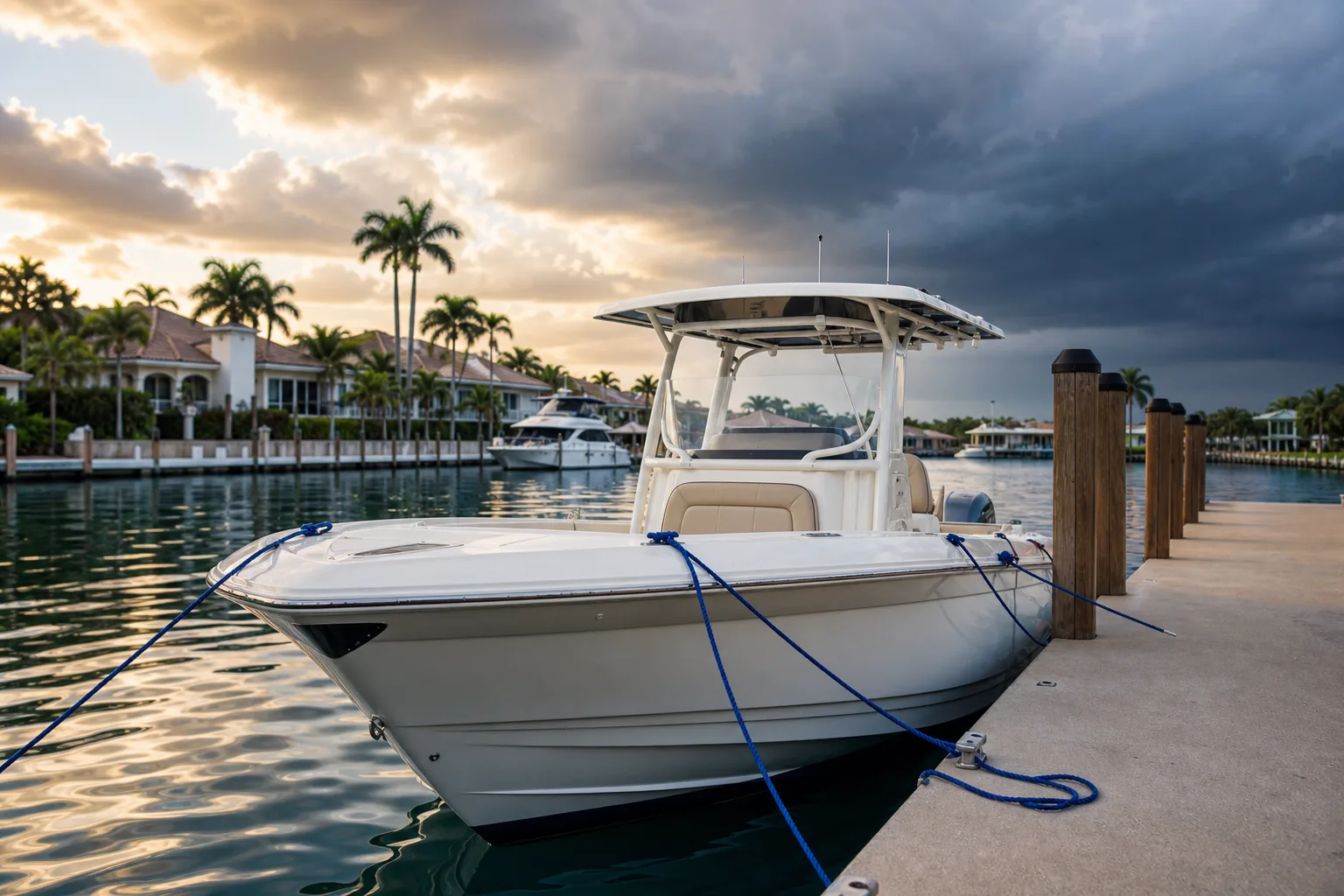
Many marine policies include what is often called a "hurricane plan" or "named-storm clause." When a tropical storm or hurricane is forecast within a certain distance of your location, usually 72 hours or less, the policy may require you to take specific protective actions. These can include:
- Hauling the vessel out of the water and securing it ashore
- Moving the vessel outside the storm's projected path
- Removing canvas, dodgers, and bimini tops
- Adding extra dock lines in a specific configuration
- Moving to a named safe harbor on an approved list
If a named storm damages or sinks your boat and you did not comply with those requirements, the insurer has grounds to deny the claim, even if the storm was a direct hit and you had no realistic time to comply.
This is particularly sharp in Palm Beach County and the Treasure Coast, where fast-moving storms have historically given boaters 36 hours or less of useful preparation time.
How to avoid it: Read your hurricane plan clause right now, not on June 2. Know the trigger: is it when a watch is issued, a warning, or when the storm center is within a certain number of miles? Know whether your marina offers approved haul-out or whether you need to arrange it independently. Then write those steps on a laminated card and keep it aboard.
Storm preparation is also the point where flood insurance becomes part of the conversation. Your boat policy handles the vessel. If floodwaters damage your dock structure or the land-based property where your trailer sits, that is a different coverage question entirely.
Bottom Line
A denied claim is not just a financial setback. It can mean losing a vessel you depend on for recreation, fishing income, or just getting out on the water with your family. The five reasons above, lapsed coverage, wrong territory, undisclosed damage, wrong valuation type, and hurricane plan failures, are all avoidable with a policy review and a conversation with an independent agent who actually reads marine policies.
At B & B Insurance Agency, we have been helping South Florida boaters find the right coverage since 1998. We shop multiple carriers, so you are not locked into one insurer's appetite for risk. If you want a second set of eyes on your current boat policy before June 1, reach out to us and we can walk through it with you.
While you are reviewing your marine coverage, it is also worth checking that your homeowners insurance and any flood insurance policies align properly with your boat storage situation, because a gap in one can leave you exposed in the other.
Cover your boat, yacht, or jet ski the right way.
Florida marine coverage from an independent agency that lives on the water too. Tell us what you ride.
Frequently asked questions
Does my homeowners insurance cover my boat if it's damaged in a storm?
Standard homeowners policies typically offer very limited or no coverage for boats. Sublimits for watercraft vary significantly by carrier and policy, so your specific policy may differ, but coverage for small craft is often quite low. A dedicated boat insurance policy is the right tool for meaningful hull and liability protection. If your boat is stored in your driveway on a trailer, there may be some property coverage under your homeowners policy, but it rarely covers storm damage or liability on the water.
What is a hurricane haul-out clause and do all boat policies have one?
A hurricane haul-out clause is a policy condition that requires you to take specific protective steps when a named storm is forecast within a set distance or timeframe. Not all policies include the same requirements, and some have no haul-out requirement at all. You must read your specific policy's named-storm section, because failing to comply with whatever your policy requires can result in a denied claim after storm damage.
Does boat insurance cover me if I take my vessel to the Bahamas?
Only if your policy's navigation territory includes the Bahamas. Many standard marine policies are written for U.S. coastal or inland waters only, and the Bahamas or other international destinations require a specific territorial extension. Ask your agent to add a Bahamas or offshore extension before you depart, because venturing outside your approved territory can void coverage for that entire trip.
What is the difference between agreed value and actual cash value on a boat policy?
Agreed value means the insurer pays a pre-set amount you negotiated at policy inception if your boat is a total loss, with no depreciation deduction. Actual cash value means the insurer pays what the boat is worth at the time of loss, after depreciation is applied, which can be significantly less than replacement cost. For most South Florida boaters with vessels that hold their value, agreed value coverage is worth asking about at renewal.
How soon do I need to act when a hurricane watch is issued to comply with my policy?
It depends on your specific policy language, which may trigger requirements at the point a tropical storm watch, a hurricane watch, or a hurricane warning is issued, or when the storm center is within a specified distance. In practice, South Florida boaters should treat any tropical system approaching within 72 hours as a reason to start the haul-out or securing process immediately, because marina schedules fill fast and delays can leave you non-compliant even if you tried to act.
Have a question about this topic?
Our experienced agents are happy to help — no pressure, just straight answers.