
TL;DR: Affordable home insurance in Lantana FL is possible, but you have to work the right levers. Raise your wind mitigation credits, bundle strategically, and let an independent agent shop at least five carriers at once. The value of each step depends on your home, policy, and available quotes.
What You Need Before You Start
Before you touch anything, pull out your current declarations page. That one-page summary tells you your dwelling coverage amount, your deductibles (including the separate windstorm or hurricane deductible), and your current discounts. If you do not have it handy, call your agent or log into your carrier portal.
You will also want:
- The year your roof was installed and the permit number if you have it
- Your home's square footage and construction type (frame, concrete block, or CBS)
- Any receipts or permits for upgrades like impact windows, a new electrical panel, or a whole-home generator
- Your current flood insurance policy if you carry one separately
Having these ready turns a 45-minute conversation into a 15-minute one, and faster conversations lead to faster savings.
Step 1: Get a Wind Mitigation Inspection
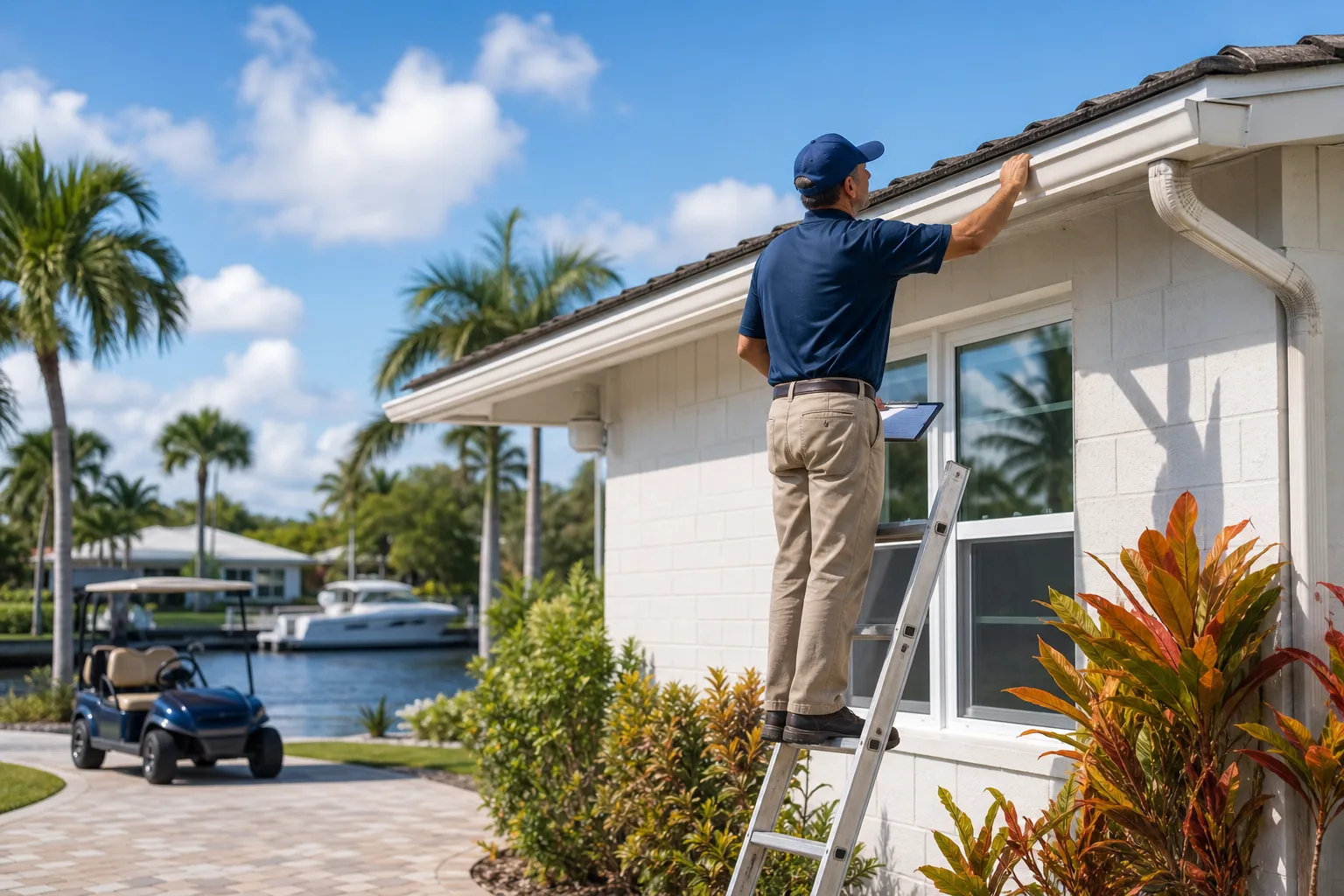
A wind mitigation inspection can be a useful first step for a Lantana homeowner. A licensed inspector spends about an hour looking at your roof shape, roof deck attachment, opening protections, and roof-to-wall connections. The report goes to your carrier, which determines credits on the wind portion of your premium. Florida DFS explains wind mitigation inspections.
Homes in Palm Beach County with hip roofs, impact glass, and newer roof-deck nailing patterns routinely see wind credits that cut hundreds of dollars off the annual bill. Inspection prices and resulting credits vary; ask an inspector for a quote and your insurer to calculate any savings.
If your report is more than five years old, get a new one. Carriers can reassess credits as roofs age, and an updated report sometimes captures improvements you made in the meantime.
Step 2: Update Your Roof, or Prove Its Condition
In Florida, the roof age question is not subtle. Many carriers will not write a new policy, or will non-renew an existing one, once a roof passes a certain age threshold. That threshold varies by carrier and by roof type.
If your roof is newer, make sure your carrier has the correct installation date on file. A surprising number of policies carry the wrong year because the original owner listed it incorrectly. A simple permit pull from the Palm Beach County property appraiser site can confirm the date.
If your roof is aging and replacement is not yet in the budget, some carriers will accept a four-point inspection showing the roof still has useful life remaining. Ask your agent whether that option is available before assuming you need to replace it immediately.
Step 3: Shop Multiple Carriers Through an Independent Agent
This is where working with an independent agent for homeowners insurance pays off most obviously. A captive agent can only offer you one company's rates. An independent agency like B & B Insurance Agency shops admitted carriers, surplus lines markets, and Citizens Property Insurance Corporation all at once.
Rates for the same house in Lantana can vary across carriers, not because one carrier is cutting corners but because each company prices Florida wind risk differently based on their own book of business. What is expensive at Carrier A might be priced competitively at Carrier B.
Here is what I would actually do: give your agent your declarations page, your wind mitigation report, and your four-point if you have one, then ask them to run at least four to five quotes. Do not just ask for the cheapest number. Ask for the best coverage-to-cost ratio, which is a different question.
Step 4: Raise Your Non-Hurricane Deductible (Carefully)
Most Florida homeowners focus on the hurricane deductible, which is usually a percentage of the dwelling coverage amount, not a flat dollar figure. But there is also an "all other perils" deductible that applies to things like fire, theft, and water damage from a burst pipe.
Raising that all-other-perils deductible from $1,000 to $2,500 or even $5,000 can meaningfully reduce your annual premium. The logic is simple: you would not file a small claim anyway because of the rate impact, so why pay for coverage of losses you would self-insure.
What I would tell my own family: only raise a deductible to an amount you can genuinely write a check for. If $5,000 would cause a hardship, stay at $2,500.
Paying too much for Florida homeowners insurance? Get a free home quote
Step 5: Bundle, But Bundle Smart
Bundling your home and auto insurance with the same carrier usually earns a multi-policy discount. That part most people know. What fewer people realize is that the bundle discount is not always the best deal.
Sometimes the savings on the auto policy disappear because the home rate at that carrier is higher than you would find elsewhere. An independent agent can model both scenarios: bundle with Carrier A versus separate with Carrier B for home and Carrier C for auto. The math sometimes surprises people.
If you own a boat, a golf cart, or a motorcycle, adding those to the mix can occasionally unlock additional credits. Ask about every policy you carry.
Step 6: Check Your Flood Insurance Separately
This is a coverage gap that comes up constantly in Lantana. Standard homeowners policies generally exclude flood; flood coverage may be available through a separate policy or endorsement. Florida DFS explains the options. But many homeowners conflate the two when they are shopping on price.
If you drop to a cheaper homeowners policy and your flood insurance is not airtight, you have saved money in one pocket and created a massive exposure in the other. Lantana sits in Palm Beach County, and storm surge and heavy rainfall flooding events are real risks here, even for homes outside the mapped high-risk flood zones.
Review your flood policy at the same time you review your homeowners. If you do not have one, get a quote. Flood coverage is often a separate policy, although some insurers offer endorsements; B & B Insurance Agency can shop National Flood Insurance Program options as well as private flood carriers that sometimes offer better rates or higher coverage limits.
Step 7: Remove Coverage You Are Actually Doubling Up On
A few line items on homeowners policies are worth reviewing for redundancy.
Scheduled jewelry or electronics riders: A separate inland marine policy may overlap with a scheduled item, but credit-card purchase protection is usually narrower and time-limited; compare terms before removing coverage.
Identity theft protection: Many carriers offer this as an add-on. Check whether your bank, credit union, or an existing membership already covers it.
Equipment breakdown: Useful, but review what your home warranty covers first.
None of these are reasons to gut your policy. But trimming genuine redundancy is clean, fair savings.
Step 8: Review Your Replacement Cost Coverage Annually
One of the most common mistakes I see is homeowners who are over-insured on their dwelling because an automatic inflation guard has been running for years, or who are under-insured because construction costs jumped and the coverage did not keep up.
Over-insuring does not pay you more after a total loss. Your policy pays to rebuild the structure, not to exceed it. If your dwelling coverage is significantly higher than what a licensed contractor would estimate to rebuild your home, you may be paying for coverage that cannot benefit you.
Under-insuring is the more dangerous error, but the point is that neither is ideal. Ask your agent to run a replacement cost estimator every year or two, especially after a major renovation.
Common Mistakes Lantana Homeowners Make When Cutting Costs
Dropping water backup coverage to save $30 a year. Water backup and sewer overflow is one of the most common home insurance claims in South Florida. It is usually a cheap add-on, and it is not included in a standard policy.
Choosing the lowest coverage just to lower the Citizens surcharge. If your home is insured with Citizens Property Insurance Corporation, you may have seen the Citizens surcharge increase. Switching carriers is fine, but make sure the replacement policy has equivalent liability and additional living expense coverage, not just a lower dwelling number.
Skipping the four-point inspection on an older home. Some carriers require it for homes over a certain age. Getting it done proactively prevents a last-minute scramble when a carrier asks for it at renewal.
Not updating the carrier after adding impact windows. If you installed impact-rated windows or doors and never sent the permits to your carrier, you may be missing opening protection credits on your wind mitigation report. That is real money sitting unclaimed.
Assuming Citizens is always the cheapest option. It sometimes is, but Citizens rates have been rising and the private market has opened up in recent years. It is worth checking both every renewal cycle.
If you are also renting out a portion of your property or running a business from home, make sure your homeowners policy actually covers those uses. Most standard policies have exclusions that create gaps for home-based businesses. A separate general liability policy may be necessary.
Bottom Line
Finding affordable home insurance in Lantana FL is not about finding the policy with the lowest number on page one. It is about understanding what drives your premium, fixing the things you can fix, and making sure an independent agent is actually shopping the full market for you.
At B & B Insurance Agency, we have been doing exactly that for South Florida families since 1998. We are local, we are independent, and we work for you, not for any one carrier. If it has been more than a year since your last full review, now is a good time.
Get a free quote or reach out to our team and we will start with your declarations page and work through every one of these steps together.
Paying too much for Florida homeowners insurance?
B & B Insurance shops multiple carriers to find you the right coverage at the right price — and we know Florida wind and flood rules cold.
Frequently asked questions
What is the fastest way to lower my home insurance premium in Lantana FL?
Getting an updated wind mitigation inspection is usually the fastest path to real savings. If your roof has a hip shape or you have impact-rated windows, the credits from a current report can reduce your wind premium significantly. Any savings depend on the home, the inspection findings, and the insurer.
Does my standard homeowners policy cover flooding in Lantana?
No. Standard homeowners policies generally exclude flood damage, including storm surge. Ask about a separate flood policy or an available endorsement. B & B Insurance Agency can quote both National Flood Insurance Program policies and private flood carriers so you can compare options.
Is Citizens Property Insurance always the cheapest option for Lantana homeowners?
Not necessarily. Citizens rates have increased in recent years and the private market has grown. An independent agent can run quotes from multiple carriers alongside Citizens so you can compare both price and coverage. It is worth reviewing the full market at every renewal rather than assuming Citizens is the low-cost choice.
How often should I review my homeowners insurance policy?
At minimum once a year, ideally 60 to 90 days before your renewal date. This gives you time to gather updated documents like a new wind mitigation report, compare carriers, and make changes without feeling rushed. Any time you renovate or make a major upgrade is also a good trigger for a review.
Can bundling my home and auto insurance save me money in Florida?
It often does, but not always. The bundle discount at one carrier does not automatically beat separate policies at two different carriers. An independent agent can model both scenarios for you so you know which approach actually saves more for your specific situation.
What is a four-point inspection and do I need one?
A four-point inspection is a limited review of your roof, electrical panel, plumbing, and HVAC systems. Many carriers require it for homes over a certain age before they will write or renew a policy. Getting one proactively helps you understand your home's insurability and prevents surprises at renewal time.
Have a question about this topic?
Our experienced agents are happy to help — no pressure, just straight answers.