

Related coverage: Homeowners Insurance
TL;DR: Actual cash value (ACV) pays what your damaged property is worth today, after depreciation. Replacement cost value (RCV) pays what it actually costs to rebuild or replace with new materials. In Florida, where hurricanes and water damage are real annual threats, that difference can be tens of thousands of dollars. For most homeowners, RCV is worth the extra premium.
At a Glance: ACV vs. Replacement Cost
| Feature | Actual Cash Value | Replacement Cost Value |
|---|---|---|
| How it pays | Depreciated value of loss | Full cost to replace/rebuild |
| Premium cost | Lower | Higher (varies by carrier and home) |
| Out-of-pocket gap after a claim | Can be significant | Minimal if limits are set right |
| Best for | Lower-value older homes, tight budgets | Most Florida homeowners |
| Depreciation applied? | Yes, to structure and contents | Usually no, or recovered after repair |
| Risk in a major hurricane | High shortfall risk | Much lower shortfall risk |
Let me walk you through what each one actually means when you file a claim, because the difference is not abstract.
What Actual Cash Value Really Means
Actual cash value is replacement cost minus depreciation. Sounds simple. Here is what it looks like in practice.
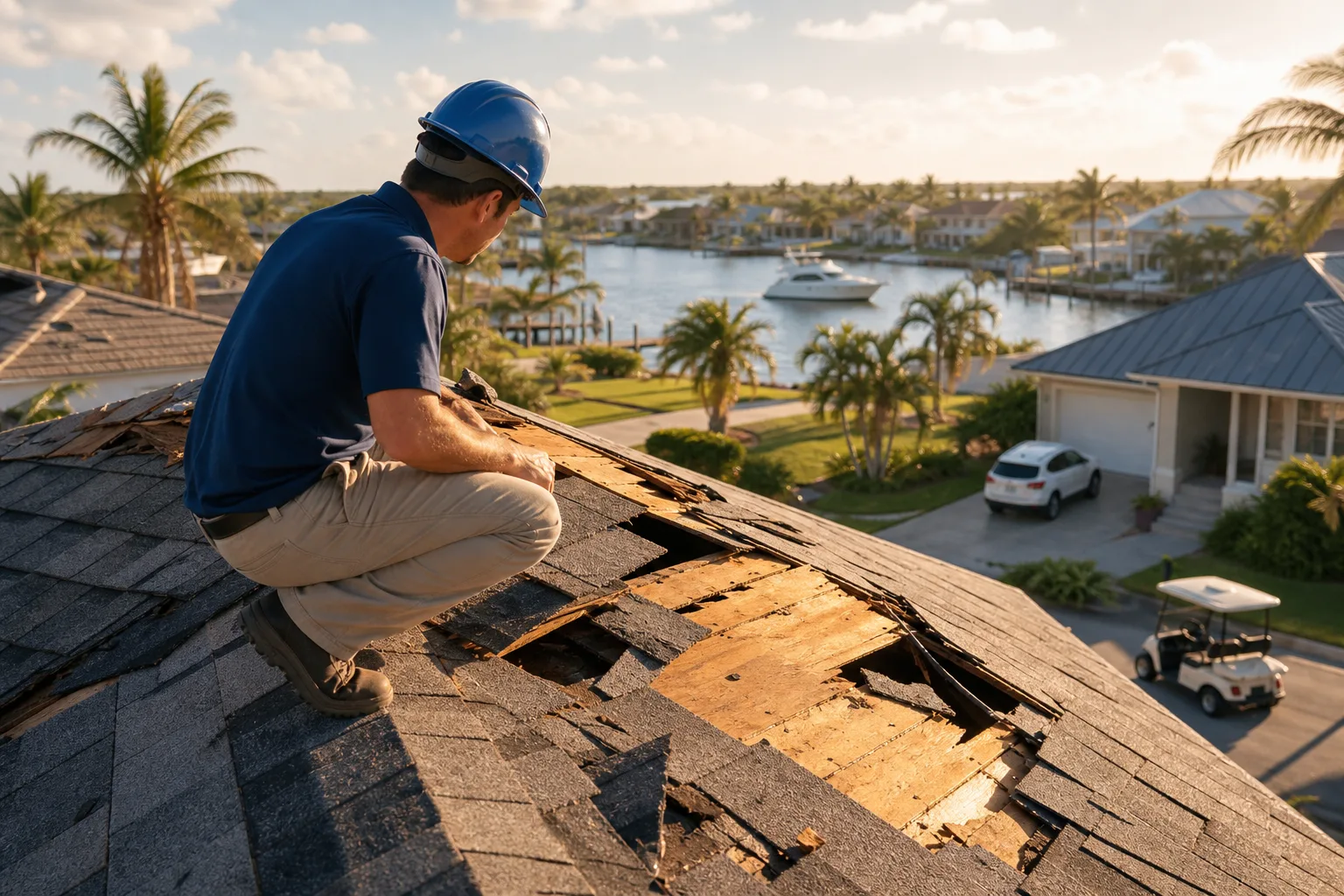
Say a hurricane tears off part of your roof. The roof cost $18,000 when it was installed ten years ago. A new roof today runs $22,000. Under an ACV policy, your insurer calculates how much that ten-year-old roof has depreciated. Depending on the carrier's depreciation schedule, you might receive $9,000 or $11,000. You owe the rest out of pocket, plus your deductible.
That gap is real money. In Palm Beach County, roofing costs have climbed sharply over the past several years, so the depreciation hit is even more painful than it used to be.
The same math applies to your personal property under a standard ACV contents endorsement. Your five-year-old refrigerator is not worth what you paid for it. Neither is your sofa, your flooring, or your HVAC unit.
Where ACV Can Make Sense
I am not going to tell you ACV is always a mistake. If you own a very old home where the structure is nearly fully depreciated anyway, and your mortgage lender does not require RCV, ACV might be acceptable. Landlords renting out older investment properties sometimes choose ACV to keep premiums down.
But for the home your family lives in? I would push hard for replacement cost.
What Replacement Cost Value Really Means
Replacement cost coverage pays to rebuild or replace your damaged property with materials of like kind and quality, without subtracting depreciation. It brings you back to where you were.
Using the same roof example: you get the $22,000 to put a new roof on, minus your hurricane deductible. That is the coverage doing its job.
There is one important detail most people miss. Many Florida carriers pay RCV claims in two stages. First, they issue an ACV payment. Once you complete the repairs and submit documentation, they release the recoverable depreciation, which is the holdback that gets you to the full replacement cost amount. You have to actually do the work to get that second check. If you pocket the first payment and skip the repairs, you leave money on the table and may create problems with your policy going forward.
Always read your policy's loss settlement language carefully. The Insurance Information Institute explains this two-step process and it is worth understanding before a claim happens, not during one.
Extended and Guaranteed Replacement Cost: One Step Further
Some carriers offer extended replacement cost, which adds a cushion, often 25% to 50% above your dwelling limit, in case construction costs spike after a widespread disaster. A few carriers offer guaranteed replacement cost, which covers the full rebuild regardless of the policy limit.
In Florida, post-hurricane construction costs surge fast. After a major storm hits an entire region, contractors are in short supply and material prices jump. An extended replacement cost endorsement is one of those things I genuinely wish more clients had when claims come in.
If you are shopping a Florida homeowners insurance policy, ask specifically whether extended replacement cost is available from any of the carriers being quoted.
The Florida Factor: Why This Matters More Here
Florida is not a typical insurance market. The state sits in one of the most hurricane-active corridors in the country. According to NOAA's historical hurricane data, Florida has been struck by more hurricanes than any other U.S. state.
That risk changes the calculus on ACV vs. RCV in a few specific ways.
Hurricane deductibles are already large. Most Florida policies carry a separate hurricane deductible expressed as a percentage of your dwelling coverage, often 2% to 5%. On a $400,000 home, that is $8,000 to $20,000 you owe before insurance kicks in. If you also have ACV coverage, the depreciation gap stacks on top of that. You could easily be $30,000 or $40,000 out of pocket on a major roof and interior claim.
Roofs age fast here. The Florida sun, humidity, and storm exposure accelerate wear. Older roofs depreciate quickly on ACV policies. Many carriers already scrutinize roof age at underwriting, and some will only insure roofs under 15 years. If your roof is older, the depreciation applied under ACV can be steep.
Mold and water damage compound costs. Florida's humidity means that water intrusion from a damaged roof or broken pipe can turn into a mold remediation project quickly. Under ACV, every component of that remediation is subject to depreciation, including drywall, insulation, and flooring.
This is also why I always bring up flood insurance in the same conversation. Homeowners policies, whether ACV or RCV, do not cover flood. That is a completely separate policy, and in South Florida it is not optional in any meaningful sense.
Paying too much for Florida homeowners insurance? Get a free home quote
What About Your Personal Property?
The dwelling coverage gets most of the attention, but your contents matter too. Furniture, appliances, electronics, clothing. Standard policies often default to ACV on personal property even when the dwelling is insured at replacement cost. That is a gap worth closing.
Ask your agent whether your contents are covered on an ACV or replacement cost basis. Adding replacement cost coverage for personal property typically costs very little and can matter a lot when you are replacing a houseful of belongings after a fire or major water event.
If you rent rather than own, the same question applies to your renters insurance policy. ACV contents coverage is common on renters policies and the depreciation problem is identical.
Premium Difference: Is RCV Worth It?
Replacement cost coverage costs more than ACV. The exact difference depends on your carrier, home age, construction type, location in Palm Beach County, and other rating factors. A rough range, and I want to be clear this is a general illustration, not a guaranteed quote, is somewhere in the neighborhood of 10% to 20% higher premium for RCV over ACV on a comparable policy.
To put that in perspective: if your annual premium under ACV is X, expect RCV to add roughly that same 10–20% range on top, but get an actual quote to know your number, because Florida homeowners insurance premiums vary enormously by carrier, location, home age, and construction type. Compare that potential added cost to a possible $20,000 to $40,000 gap in a major hurricane claim and the math is pretty clear.
Here is what I would tell my own family: pay for the replacement cost coverage. The premium difference is not the place to economize on a Florida home policy.
Because B & B Insurance Agency is an independent agency, we can quote your home across multiple carriers and find you the best available combination of RCV coverage and competitive premium. That is a real advantage over going to a single-carrier agent. Reach out for a free quote and we will run the comparison for you.
Common Coverage Gaps People Miss
Even with a solid RCV policy, there are a few gaps worth knowing about.
- Code upgrade coverage. If a storm damages your home and local building codes require upgrades during repair, a standard policy may not cover the extra cost. Look for an ordinance or law endorsement.
- Detached structures. Your garage, fence, or shed may default to ACV or carry a separate, lower limit. Confirm what applies.
- Roof surfacing depreciation schedules. Some Florida carriers apply separate, steeper depreciation to roof coverings even on an otherwise RCV policy. Read the endorsements.
- Personal property sublimits. Jewelry, electronics, and collectibles often have per-category caps that apply regardless of RCV vs. ACV designation.
The Florida Department of Financial Services has a homeowners consumer guide that outlines what carriers are and are not required to offer, which is worth bookmarking.
Verdict: Which Should You Choose?
For most homeowners in Lantana, West Palm Beach, and across Palm Beach County, replacement cost value coverage is the right call. The premium difference is real but manageable. The financial gap in an ACV claim, especially after a major hurricane, can be devastating.
Choose ACV only if you have a very specific reason: an older investment property, a tight budget that genuinely cannot stretch, or a home so fully depreciated that the gap is minimal. Even then, discuss it with your agent before deciding.
And while you are reviewing your home policy, make sure the dwelling limit itself reflects what it would actually cost to rebuild at today's construction prices. An RCV policy set to an outdated limit still leaves you short. Rebuilding costs in South Florida have moved significantly, and limits that were accurate three or four years ago may not be today.
At B & B Insurance Agency, we have been helping South Florida families sort through exactly these questions since 1998. We shop multiple carriers, explain the options in plain English, and make sure you know what you are buying before you sign. Get a homeowners quote or contact us directly and we will walk through it together.
Paying too much for Florida homeowners insurance?
B & B Insurance shops multiple carriers to find you the right coverage at the right price, and we know Florida wind and flood rules cold.
Frequently asked questions
What is the main difference between actual cash value and replacement cost on a Florida home policy?
Actual cash value pays you what your damaged property is worth today after depreciation is subtracted. Replacement cost pays what it actually costs to repair or replace with new materials, without that depreciation deduction. On a major Florida hurricane claim, that difference can easily be $20,000 or more.
Does replacement cost coverage apply to both my home's structure and my personal belongings?
Not automatically. Many Florida policies cover the dwelling on a replacement cost basis but default to actual cash value for personal property. You need to check your policy's contents loss settlement language and ask your agent about adding replacement cost coverage for personal property, which usually costs very little extra.
How does the two-payment process work on a replacement cost claim in Florida?
Most carriers first issue an actual cash value payment when the claim is approved. Once you complete the repairs and submit documentation proving the work is done, they release the recoverable depreciation, bringing the total up to the full replacement cost amount. If you skip the repairs, you typically do not receive that second payment.
Are there any Florida-specific issues that make replacement cost coverage more important here than in other states?
Yes. Florida's hurricane deductibles are already large, often 2% to 5% of your dwelling value, meaning you are already absorbing a significant out-of-pocket cost before coverage applies. Stacking an ACV depreciation gap on top of that can leave homeowners in a very difficult financial position after a major storm. Florida's climate also accelerates roof wear, which increases the depreciation applied under ACV policies.
What is extended replacement cost and should I ask about it for my South Florida home?
Extended replacement cost adds a cushion above your dwelling limit, typically 25% to 50%, to cover situations where construction costs spike after a widespread disaster. In Florida, post-hurricane demand surges for contractors and materials are common, making this endorsement especially valuable. Ask your agent whether it is available from the carriers being quoted on your policy.
Can I switch from actual cash value to replacement cost on an existing Florida home policy?
In many cases yes, though the carrier may require a current inspection or appraisal of the home before upgrading your coverage. Reach out to your agent to discuss the change and confirm your dwelling limit is also set to an accurate current rebuild cost, since an RCV policy with an outdated limit still leaves a gap.
Related Coverage from B & B
Have a question about this topic?
Our experienced agents are happy to help — no pressure, just straight answers.


